
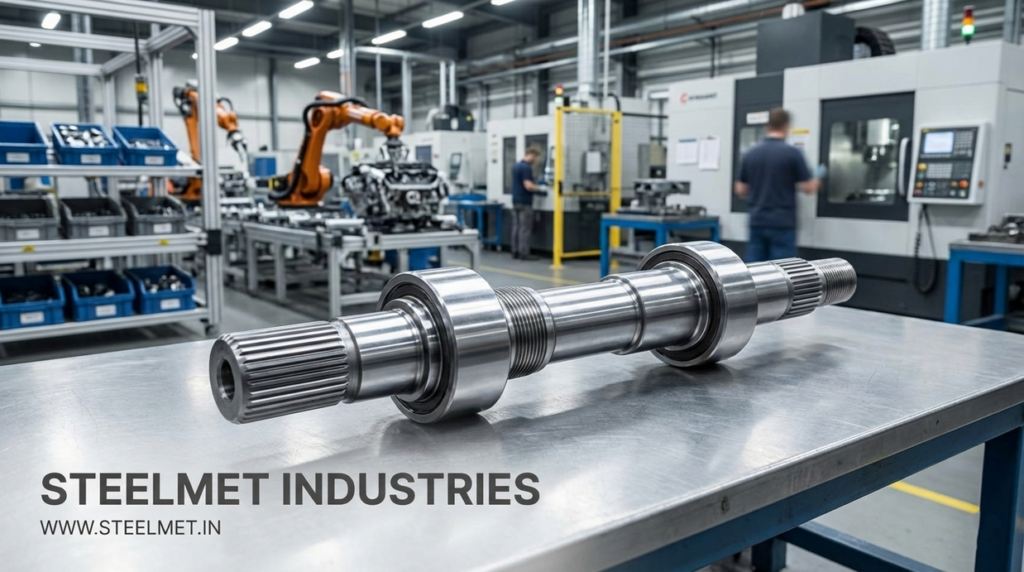
Axle Shaft – Steel Bright Bar Applications
An axle shaft is a critical drivetrain component responsible for transmitting torque from the
differential to the driven wheels while simultaneously supporting vehicle weight and dynamic loads.
Unlike purely rotational shafts, axle shafts operate under a combined state of
torsional stress, bending stress, shock loading, and continuous fatigue cycles.
Material selection therefore directly influences durability, safety, and service life.
In modern automotive, agricultural, and heavy equipment manufacturing,
steel bright bars are widely used as the raw material for axle shafts because they provide
controlled chemistry, predictable mechanical properties, excellent straightness, and machining-ready surfaces.
These attributes are essential for achieving concentricity, spline accuracy, and fatigue resistance
in safety-critical axle assemblies.
← Back to Automotive & Vehicle Components
|
← All Bright Bar Applications
Where Axle Shafts Are Used
- Passenger cars and light commercial vehicles
- Trucks, buses, and multi-axle vehicles
- Tractors and agricultural machinery
- Construction and earthmoving equipment
- Off-road, defence, and utility vehicles
- Material handling and industrial transport systems
Load Conditions Acting on Axle Shafts
Axle shafts are subjected to multiple simultaneous load paths during operation.
Understanding these loads is essential when selecting bright bar material and processing routes.
| Load Type | Source | Material Requirement |
|---|---|---|
| Torsional Load | Engine torque transmission | High yield strength and torsional rigidity |
| Bending Load | Vehicle weight and road irregularities | Fatigue resistance and toughness |
| Shock Load | Braking, potholes, off-road impact | Impact toughness and ductility |
| Cyclic Fatigue | Continuous rotation | Clean steel with low inclusion content |
Why Steel Bright Bars Are Used for Axle Shafts
- High torsional strength for reliable power transmission
- Excellent fatigue resistance under cyclic bending and torsion
- Superior straightness for vibration-free rotation
- Consistent diameter and roundness for bearing seats
- Good machinability for splines, flanges, and shoulders
- Predictable response to heat treatment
Axle Shaft – Typical Geometry & Machined Features
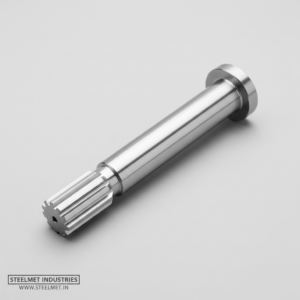
Typical axle shaft machined from steel bright bar with splined end
Axle shafts typically incorporate splines for torque transmission,
bearing journals for wheel hub support, and flanges or threaded ends for assembly.
Maintaining concentricity between these features is critical to avoid vibration,
uneven bearing wear, and premature fatigue failure.
Steel Grades Commonly Used for Axle Shafts
| Application Category | Typical Grade | Selection Rationale |
|---|---|---|
| Light-duty automotive axles | EN8, EN8D, C45 | Balanced strength, machinability, and cost |
| Medium & heavy commercial vehicles | EN19 | Higher fatigue strength and core toughness |
| High-load / performance axles | 42CrMo4, EN24 / 4340 | Superior torsional strength and shock resistance |
Manufacturing & Processing Considerations
- Cold drawn or peeled & polished bright bars for dimensional consistency
- CNC turning for diameter and concentricity control
- Spline cutting or spline rolling depending on fatigue requirements
- Induction hardening or quench & tempering for strength enhancement
- Shot peening for improved fatigue life (where specified)
Where Bright Bars May NOT Be Suitable
Bright bars may not be the optimal choice for axle shafts in certain conditions:
- Very large axle diameters where forging is required for grain flow
- Extremely high-impact applications without post-machining heat treatment
- Cost-sensitive designs where tolerance and straightness are non-critical
Supply & Manufacturing Realities
For axle shaft manufacturing, buyers should consider practical supply parameters such as
straightness limits, diameter tolerances, surface condition, and machining allowance.
Bright bars are typically supplied in straight lengths suitable for CNC processing,
with options for VD route steel where fatigue reliability and cleanliness are critical.
Buyer Decision Checklist
- Expected torque and bending load range
- Required fatigue life and safety factor
- Spline geometry and machining method
- Heat treatment route and hardness range
- Traceability and inspection requirements
Discuss axle shaft material selection with Steelmet Industries
Related Components
- Drive Shafts
- Propeller Shafts
- Splined Shafts
FAQs
Why do axle shafts require high fatigue strength?
Axle shafts experience millions of load cycles during service.
Insufficient fatigue strength can lead to crack initiation and catastrophic failure.
Is straightness critical in axle shaft material?
Yes. Poor straightness causes vibration, uneven bearing loading, and accelerated wear.
Are VD route steels recommended for axle shafts?
VD route steels are preferred for safety-critical and export-grade axle applications
where internal cleanliness and fatigue reliability are essential.
Can bright bars be supplied pre-heat-treated?
Depending on grade and specification, supply can be arranged in annealed,
normalized, or quenched & tempered condition.
Contact for Enquiries
For sourcing steel bright bars suitable for axle shaft manufacturing: