
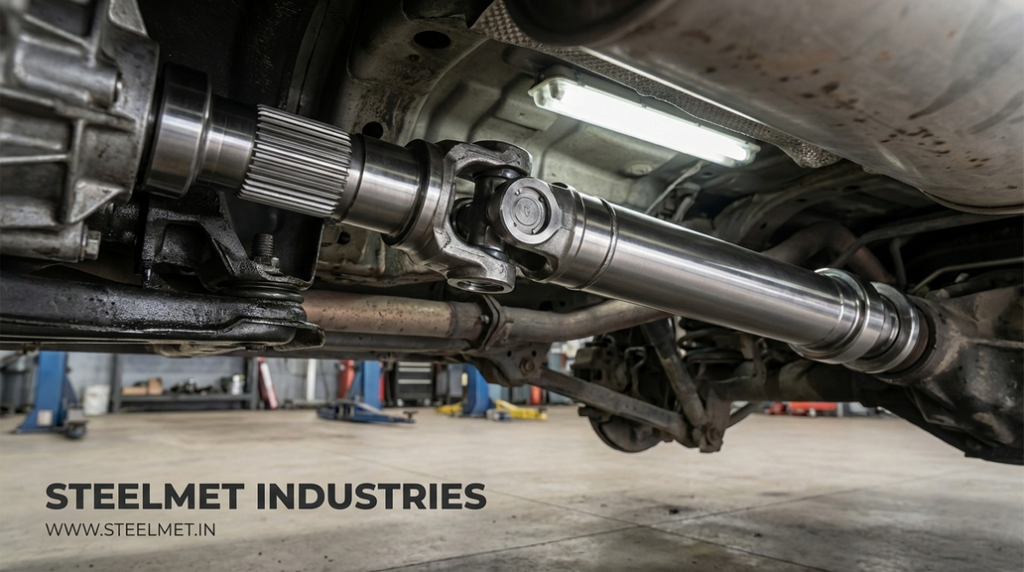
Use of Steel Bright Bars in Drive Shaft Manufacturing
A drive shaft is a critical drivetrain component that transfers mechanical power
from the transmission or differential to the driven wheels or axles.
In automotive, agricultural, and heavy engineering equipment, the drive shaft is subjected to
continuous torsional loads, cyclic fatigue, bending stresses, and rotational imbalance.
Material selection at the raw material stage directly impacts performance, vibration behaviour,
service life, and failure risk.
For this reason, steel bright bars are widely used as the starting material
for manufacturing solid drive shafts. Their controlled dimensional accuracy, straightness,
surface finish, and predictable metallurgical properties make them suitable for precision
machining, heat treatment, and fatigue-critical applications.
← Automotive Applications
|
← All Bright Bar Applications
Applications of Drive Shafts
- Passenger vehicles and commercial vehicles
- Tractors and agricultural machinery
- Construction and earthmoving equipment
- Industrial material handling vehicles
- Off-road and heavy-duty utility equipment
Where Bright Steel Bars Are Suitable for Drive Shafts
Bright bars are preferred where drive shafts are manufactured as
solid shafts requiring precision machining.
Cold drawn or peeled and polished bars provide a consistent base material
for turning, spline cutting, bearing journal machining, and controlled heat treatment.
- Solid drive shafts with splines or keyways
- Medium to high torque transmission systems
- Applications requiring tight straightness control
- Machined shafts with bearing and seal interfaces
Why Bright Bars Are Used to Manufacture Drive Shafts
- High torsional strength for continuous torque transmission
- Excellent straightness to minimise vibration and imbalance
- Superior surface finish for bearing and seal life
- Uniform mechanical properties across length
- Predictable machinability for splines, shoulders, and grooves
Drive Shaft – Typical Geometry & Machined Features
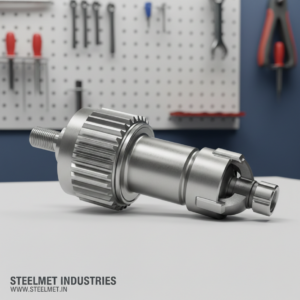
Drive shafts typically incorporate splines, bearing journals, shoulders,
U-joint or flange interfaces, and transition radii.
Dimensional accuracy and surface integrity at these features are critical
to prevent premature wear, noise, and fatigue failure.
Drive Shaft Manufacturing Process Using Bright Bars
- Cutting bright bars to controlled length tolerances
- CNC turning to achieve shaft concentricity and diameter accuracy
- Spline cutting or rolling based on design requirements
- Heat treatment to achieve required strength and toughness
- Final grinding or finishing for bearing fits and balance control
Steel Grades Commonly Used for Drive Shafts
| Application | Typical Grade | Reason for Selection |
|---|---|---|
| Light-duty vehicles | EN8, C45 | Balanced strength, machinability, and cost |
| Commercial vehicles | EN19 | Higher fatigue resistance and torsional strength |
| High-load / off-road equipment | 42CrMo4 | Superior toughness and shock load resistance |
Manufacturing Realities Buyers Must Consider
| Parameter | Why It Matters |
|---|---|
| Straightness | Directly affects vibration, balancing, and bearing life |
| Surface finish | Critical for seal performance and wear resistance |
| Length tolerances | Reduces machining allowances and material waste |
| Heat treatment response | Ensures consistent mechanical properties after processing |
Where Bright Bars May NOT Be Suitable
Bright steel bars may not be the optimal choice in the following cases:
- Very large diameter hollow drive shafts requiring tubes
- Welded assemblies where hot rolled sections are specified
- Applications requiring forged grain flow for extreme shock loads
- Ultra-high-speed shafts demanding specialised balance treatments
Buyer Decision Checklist for Drive Shaft Material
- Required torque and fatigue life
- Straightness and concentricity limits
- Machining processes involved (splines, journals, grooves)
- Heat treatment method and depth
- Traceability and quality documentation
Common Drive Shaft Failures
- Torsional twisting due to overload
- Journal wear from poor surface finish
- Noise and vibration from misalignment
- Cracking caused by improper metallurgy or heat treatment
Using quality bright bars with controlled chemistry and processing
significantly reduces these failure modes.
FAQs
Why is straightness critical in drive shafts?
Poor straightness leads to vibration, premature bearing wear,
and imbalance at operating speeds.
Are solid bright bars suitable for all drive shafts?
They are ideal for solid shafts but not for hollow or tube-based designs.
Which grade is preferred for heavy vehicles?
EN19 and 42CrMo4 are commonly selected for higher torque and fatigue demands.
Is VD route steel required?
VD route steels are recommended for fatigue-critical and export-grade applications.
Contact for Enquiries
For sourcing steel bright bars suitable for drive shaft manufacturing:
Need guidance on grade selection or straightness requirements?
Discuss your application with our team.