
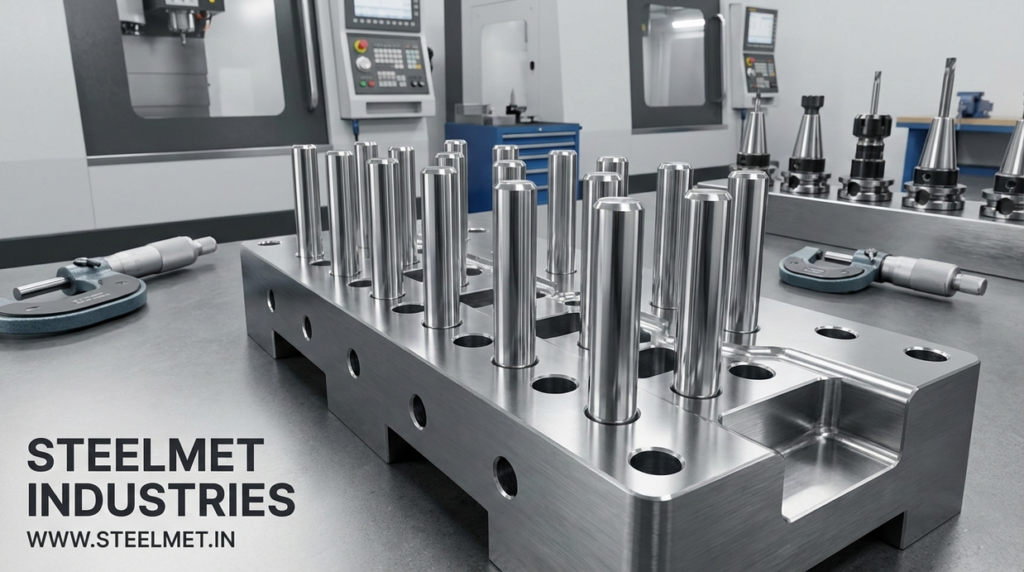
Use of Steel Bright Bars in Precision Dowel Pin Manufacturing
A precision dowel pin is a locating and alignment component used to
accurately position mating parts in assemblies, jigs, fixtures, dies and moulds.
Its primary function is not load transmission but positional accuracy and repeatability.
Dowel pins are subjected to shear loads, bearing stresses and repeated assembly cycles,
making dimensional accuracy and surface integrity critical.
For these reasons, steel bright bars are widely used as the base raw material
for manufacturing precision dowel pins. Bright bars provide tight diameter control,
excellent roundness and a uniform microstructure that supports grinding, hardening
and long-term dimensional stability.
← General Engineering Applications
|
← All Bright Bar Applications
Where Precision Dowel Pins Are Used
- Jigs and fixtures for repeatable positioning
- Machine tool assemblies
- Die and mould alignment systems
- Automotive sub-assemblies
- Robotics and industrial automation equipment
Why Steel Bright Bars Are Used to Manufacture Dowel Pins
- Extremely tight diameter tolerances after grinding
- Superior surface finish suitable for press and slip fits
- Excellent roundness and concentricity
- Uniform metallurgical structure for predictable hardening
- Consistent mechanical properties along the length
Dowel Pin – Geometry & Functional Surfaces
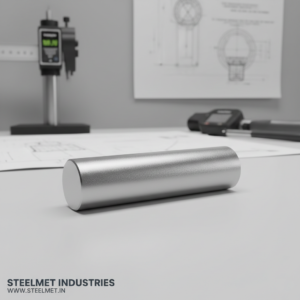
Precision dowel pin machined from steel bright bar showing ground diameter and chamfered ends
Precision dowel pins typically have a fully ground outer diameter, chamfered or radiused ends
and controlled length tolerance. The functional surface is the cylindrical diameter, which
must maintain accuracy under shear and bearing loads without galling or deformation.
Manufacturing Process Using Bright Bars
- Cutting bright bar into controlled-length blanks
- Centerless grinding to achieve diameter tolerance
- End chamfering for ease of assembly
- Heat treatment (hardening and tempering)
- Final grinding for size and surface finish
- 100% or batch inspection depending on application
Fit Types and Functional Requirements
| Fit Type | Typical Use | Material Requirement |
|---|---|---|
| Press Fit | Permanent location | High surface finish, controlled hardness |
| Slip Fit | Removable alignment | Precise diameter, low friction surface |
| Transition Fit | Controlled assembly | Consistent roundness and tolerance |
Steel Grades Used for Precision Dowel Pins
| Application | Steel Grade | Reason |
|---|---|---|
| General locating pins | EN8, C45 | Balanced strength and machinability |
| High wear applications | EN31 | High hardness after heat treatment |
| Critical tooling | 42CrMo4 | Higher toughness with strength |
Where Bright Bars May NOT Be Suitable
Bright bars may not be suitable for dowel pins in applications requiring extremely high
corrosion resistance (marine or chemical environments) or where non-ferrous materials
are specified for electrical or magnetic reasons. In such cases, stainless steels or
special alloys may be required instead of carbon or alloy bright bars.
Manufacturing & Supply Realities
- Diameter tolerance is typically achieved after grinding, not drawing
- Length tolerances depend on cutting and facing process
- Straightness of bright bar affects grinding efficiency
- Batch traceability is important for tooling and OEM supply
Buyer Decision Checklist
- Required fit type and tolerance class
- Shear and bearing load expectations
- Hardness and wear life requirement
- Surface finish specification
- Inspection and traceability needs
Related Components
- Guide Pins
- Locating Bushes
- Clevis Pins
Why Steelmet Industries?
- Bright bars suitable for precision-ground components
- Strict diameter and straightness control
- VD route steels available for critical tooling
- NABL-certified testing and inspection support
- Consistent quality and traceability
FAQs
Why are dowel pins considered precision components?
They control positional accuracy of assemblies, making tight tolerances and repeatability essential.
Which steel grade is commonly used?
EN8 and EN31 are widely used depending on wear and hardness requirements.
Are dowel pins always hardened?
Most precision dowel pins are hardened to improve wear resistance and service life.
Can VD route steel be used?
Yes, VD route steels are preferred for critical tooling and export-oriented applications.
Contact for Enquiries
For sourcing steel bright bars for precision dowel pin manufacturing: