
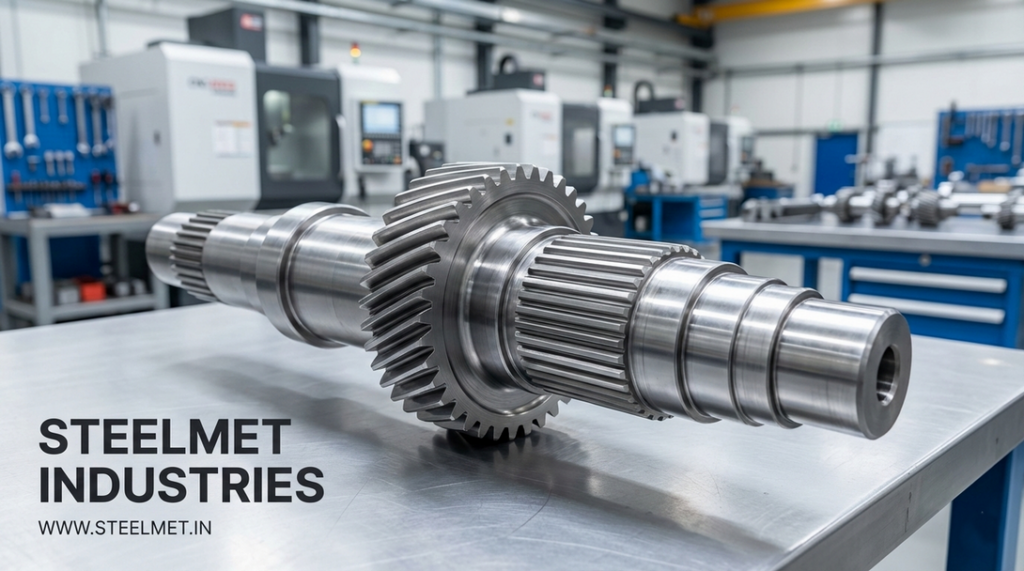
Use of Steel Bright Bars in Gear Shaft Manufacturing
A gear shaft is a critical rotating component used in automotive,
tractor and industrial transmission systems. It transfers torque between gears
while simultaneously withstanding bending stresses at gear seats, shoulders and
bearing locations. Gear shafts operate under continuous cyclic loading, making
material selection and dimensional control decisive factors for service life.
In manufacturing environments, steel bright bars are widely used as
raw material for gear shafts because they offer controlled straightness, tight
dimensional tolerances and predictable mechanical properties. These attributes
directly influence gear alignment, noise levels, fatigue performance and heat
treatment outcomes.
← Automotive Applications
|
← All Bright Bar Applications
Applications of Gear Shafts
- Automotive manual and automatic gearboxes
- Truck and bus transmission systems
- Tractor and agricultural machinery gear trains
- Industrial speed reducers and gearboxes
- Construction and earthmoving equipment drivetrains
Why Bright Bars Are Used to Manufacture Gear Shafts
- High straightness to minimise runout and gear mesh errors
- Tight diameter tolerance for accurate gear and bearing fits
- Uniform core properties for predictable fatigue behaviour
- Superior surface finish reducing machining time
- Consistent response to induction and case hardening
Gear Shaft – Typical Geometry & Machined Features
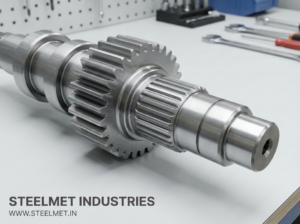
Machined features of a gear shaft manufactured from bright bar material
Gear shafts typically include bearing journals, gear mounting seats, splines or
keyways and shoulder transitions. Any deviation in concentricity or straightness
directly affects gear tooth loading, noise generation and bearing life.
Load Paths and Stress Considerations
| Section | Primary Stress | Material Requirement |
|---|---|---|
| Gear mounting seat | Bending + contact stress | High core strength, dimensional stability |
| Bearing journals | Surface fatigue | Good finish, hardness compatibility |
| Spline / keyway | Torsional shear | Toughness and notch resistance |
Manufacturing Process Using Bright Bars
- Cutting bright bars to controlled lengths
- CNC turning for diameter and shoulder accuracy
- Gear hobbing or shaping operations
- Spline or keyway machining
- Case hardening or induction hardening as required
- Finish grinding for runout and tolerance control
Steel Grades Commonly Used for Gear Shafts
| Application | Typical Grade | Reason |
|---|---|---|
| Light-duty transmissions | EN8, C45 | Balanced strength and machinability |
| Automotive & tractor gearboxes | EN19 | Higher fatigue and torsional strength |
| High-load industrial drives | 20MnCr5 | Excellent case hardening response |
Where Bright Bars May NOT Be Suitable
- Very large diameter shafts requiring forged blanks
- Applications demanding deep carburised layers beyond section limits
- Highly complex geometries needing near-net forging
Manufacturing & Supply Realities
For gear shaft production, straightness control, concentricity and consistent
chemistry are as important as grade selection. Bright bars are typically supplied
in straight lengths with machining allowance built in. Manufacturers should
define tolerance bands, heat treatment routes and inspection criteria at the
material procurement stage.
Buyer Decision Checklist
- Defined torque and bending load requirements
- Heat treatment method and depth requirement
- Straightness and runout limits
- Machining process capability
- Traceability and test certification needs
FAQs
Why is straightness critical in gear shafts?
Poor straightness increases runout, leading to uneven gear tooth loading,
vibration and premature wear.
Which steel grade is preferred for case-hardened gear shafts?
20MnCr5 is commonly used where surface hardness and tough core strength are required.
Can EN19 be induction hardened?
Yes. EN19 responds well to induction hardening for medium to high torque applications.
Are bright bars suitable for precision gearboxes?
Yes, provided straightness, chemistry and heat treatment are tightly controlled.
Contact for Enquiries
For sourcing steel bright bars for gear shaft manufacturing: