
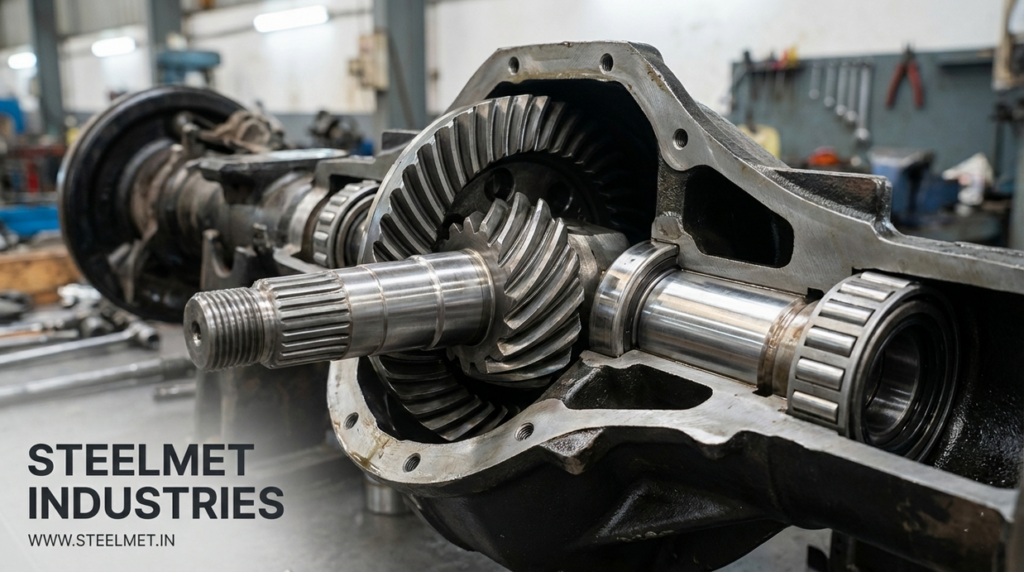
Use of Steel Bright Bars in Differential Pinion Shaft Manufacturing
A differential pinion shaft is a critical drivetrain component used
inside vehicle axle assemblies. It transmits rotational motion from the
propeller shaft to the crown wheel, enabling torque distribution to
drive wheels.
To manufacture differential pinion shafts, steel bright bars are
used as raw material due to their superior straightness, controlled
chemical composition and consistent mechanical properties. These
characteristics are essential to withstand torsional loads, impact
forces and continuous cyclic stress.
← Automotive, Agri & Heavy Machinery Group
|
← All Bright Bar Applications
Where Differential Pinion Shafts Are Used
- Passenger vehicles: Transmit engine power to rear or front axle assemblies.
- Commercial vehicles: Handle high torque in trucks and buses.
- Agricultural tractors: Operate under fluctuating loads in field conditions.
- Construction equipment: Used in loaders, dumpers and graders.
- Off-road vehicles: Designed for shock loads and terrain impact.
Why Bright Bars Are Used to Manufacture Differential Pinion Shafts
- High torsional strength: Essential to handle continuous torque transfer.
- Dimensional accuracy: Ensures precise gear meshing and bearing fitment.
- Superior surface finish: Reduces wear at bearing contact points.
- Excellent straightness: Prevents vibration and noise during rotation.
- Uniform metallurgy: Minimizes risk of fatigue failure.
Differential Pinion Shaft – Geometry & Machined Features
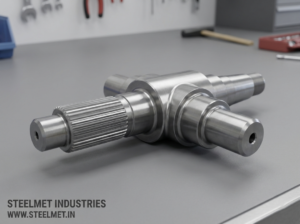
Pinion shafts typically feature splines or gear mounting profiles,
precision bearing journals and filleted transitions. These geometries
are designed to reduce stress concentration and improve fatigue life.
Manufacturing Process Using Bright Bars
- Cutting bright bar to required length
- CNC turning for diameter accuracy
- Gear spline machining
- Heat treatment (quenching & tempering)
- Final grinding for bearing journals
- Magnetic particle inspection (optional)
Design Considerations
- Surface roughness at bearing zones
- Fillet radius to avoid stress risers
- Run-out and concentricity limits
- Proper hardness gradient
Surface Treatments & Heat Processes
- Induction hardening
- Carburizing (for case hardening grades)
- Nitriding
- Shot peening for fatigue resistance
Steel Grades Used for Differential Pinion Shafts
| Application | Steel Grade | Why Used |
|---|---|---|
| Standard vehicles | EN8 / C45 | Balanced strength and machinability |
| Commercial vehicles | EN19 / 4140 | Higher torsional and fatigue strength |
| Heavy duty / export | 42CrMo4 / EN24 | Superior toughness and impact resistance |
| Case hardened shafts | 20MnCr5 | Hard surface, tough core |
What Happens If Wrong Material Is Used?
- Premature gear tooth wear
- Noise and vibration in drivetrain
- Cracking at fillet areas
- Shaft twisting under load
- Bearing seizure
Using improper steel grades or poorly processed raw material
can lead to catastrophic drivetrain failure.
Industry Standards & Tolerances
- Surface roughness: Ra 0.4 – 0.8 μm
- Concentricity: ≤ 0.02 mm
- ISO fit classes: h6 / h7
- Hardness range: 28 – 40 HRC (application dependent)
Related Drivetrain Components
- Gear Shafts
- Drive Shafts
- Axle Shafts
Why Steelmet Industries?
- Precision bright bars for drivetrain components
- Supply of EN8, EN19, EN24 and special steels
- VD route materials for critical applications
- NABL-certified testing support
- Complete traceability
FAQs
What material is best for pinion shafts?
EN19 and 42CrMo4 are preferred for high load applications.
Why are bright bars preferred?
They offer tight tolerance and consistent metallurgy.
Are pinion shafts heat treated?
Yes, to improve wear resistance and fatigue life.
Can VD route steel be used?
Yes, for export and safety-critical applications.
Contact for Enquiries
For sourcing bright bars for differential pinion shaft manufacturing: