
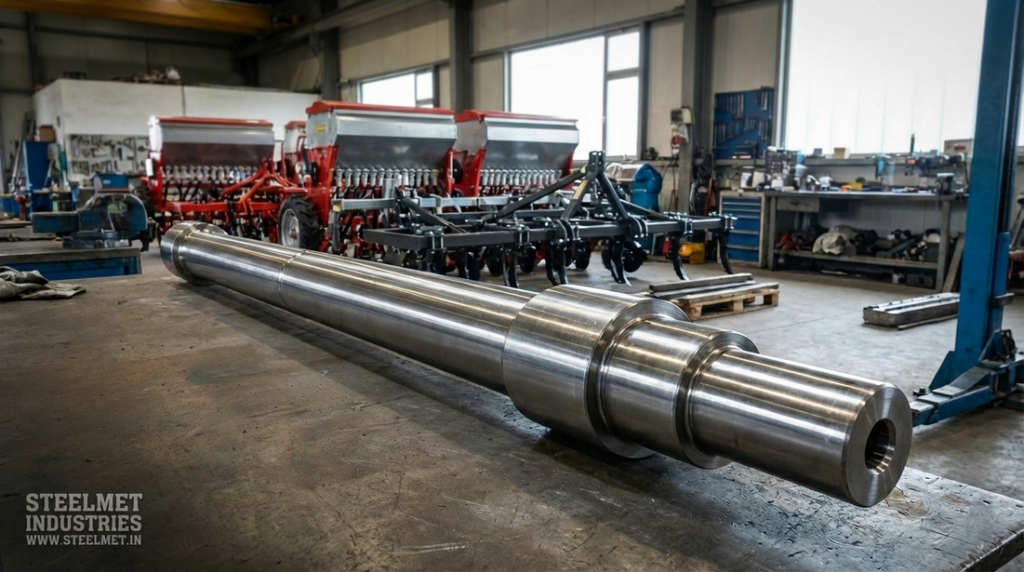
Seed Drill Shaft – Application of Bright Steel Bars in Agricultural Sowing Equipment
A seed drill shaft is a critical rotating and alignment component used in seed drill and sowing machines to transmit motion, maintain uniform seed distribution, and ensure consistent depth and spacing during planting operations. In agricultural machinery, especially seed drills used across varied soil conditions, the shaft must operate reliably under continuous rotation, dust exposure, minor misalignment, and cyclic loading. Bright steel bars are commonly selected as raw material for seed drill shafts due to their dimensional accuracy, straightness, machinability, and predictable mechanical behavior during fabrication and field use.
Unlike rough structural members, seed drill shafts are functional machine elements that directly influence planting accuracy and equipment reliability. Any deviation in straightness, diameter, or surface finish can lead to uneven seed flow, premature bearing wear, or vibration during operation. For this reason, manufacturers and fabricators prefer bright steel bars as input material when producing seed drill shafts for agricultural implements.
Material Grades Commonly Used for Seed Drill Shafts
Seed drill shafts are typically manufactured using low to medium strength carbon steel grades that balance machinability, availability, and field performance. The most commonly used grades in local agricultural machinery manufacturing include MS, Low Carbon (LC), and EN8 bright steel bars.
MS and Low Carbon bright bars are widely used for light to medium-duty seed drills where ease of machining, weldability, and cost control are primary considerations. These grades offer sufficient strength for seed metering mechanisms, drive shafts, and intermediate shafts that do not experience high torque or shock loading.
EN8 bright steel bars are selected for heavier seed drills, higher operating speeds, or designs requiring improved strength and wear resistance. EN8 provides better tensile strength and fatigue resistance compared to plain MS grades while remaining compatible with standard turning, keyway cutting, and surface finishing operations.
Manufacturing and Machining Considerations
Seed drill shafts are typically produced through CNC or conventional turning operations starting from bright round bars or, in certain designs, bright square bars that are later machined to profile. Straightness of the incoming bright bar directly affects machining accuracy, bearing alignment, and final assembly fitment.
Common machining operations include turning to diameter, shoulder formation, keyway milling for sprocket or gear mounting, and drilling or threading at shaft ends. Bright bars reduce machining time by eliminating excessive scale removal and by providing consistent starting dimensions.
Surface finish plays an important role in reducing friction at bearing locations and minimizing wear in dusty agricultural environments. Bright steel bars provide a smoother baseline surface compared to hot rolled material, improving overall component life and reducing the likelihood of premature failure during field operation.
Technical Reference Tables
| Steel Grade | Key Properties | Suitability for Seed Drill Shafts |
|---|---|---|
| MS Bright Bar | Good machinability, economical, weldable | Suitable for light-duty seed drill shafts and non-critical drives |
| Low Carbon (LC) | Low strength, high ductility, easy forming | Used where torque loads are low and cost sensitivity is high |
| EN8 | Higher tensile strength, better fatigue resistance | Preferred for medium to heavy-duty seed drill shafts |
| Application Requirement | Material Property Needed | Bright Bar Advantage |
|---|---|---|
| Smooth rotation | Straightness and dimensional consistency | Reduced vibration and bearing wear |
| Accurate seed metering | Controlled diameter and alignment | Uniform motion transfer |
| Ease of fabrication | Machinability | Lower machining time and scrap |
Buyer Decision Checklist
- Confirm shaft duty level and operating speed before selecting MS, LC, or EN8 grade
- Verify straightness requirements to avoid assembly and vibration issues
- Check diameter tolerance compatibility with bearings and sprockets
- Assess surface finish needs for dust-prone agricultural environments
- Ensure batch consistency for repeat fabrication and spare part supply
Supply Realities for Seed Drill Shaft Manufacturers
Bright steel bars for seed drill shafts are commonly supplied in standard mill lengths, with cutting and machining allowances considered during procurement. Straightness tolerances are critical, especially for longer shafts used across wide seed drill frames.
Fabricators should account for machining allowance based on final diameter and surface finish requirements. Consistent batch supply is important for OEMs producing multiple seed drill units or maintaining after-sales spare inventories.
Where Bright Bars May Not Be Suitable
Bright steel bars may not be suitable for very low-cost welded farm tools where dimensional accuracy and rotation are not required. They are also unnecessary for non-rotating structural members or rough agricultural implements where hot rolled or fabricated sections are sufficient.
FAQs
Why are bright steel bars preferred over hot rolled bars for seed drill shafts?
Bright bars offer better straightness, dimensional accuracy, and surface finish, which are essential for smooth rotation and accurate seed distribution.
Is EN8 always required for seed drill shafts?
No. EN8 is used when higher strength or durability is needed, while MS or LC grades are adequate for lighter duty seed drills.
Can seed drill shafts be manufactured from square bright bars?
Yes. In some designs, square bright bars are used and later machined to the required shaft profile.
Contact for Material Enquiries
For grade selection, size availability, and sourcing of bright steel bars suitable for seed drill shaft manufacturing, please contact Steelmet Industries for technical discussion and supply support.