
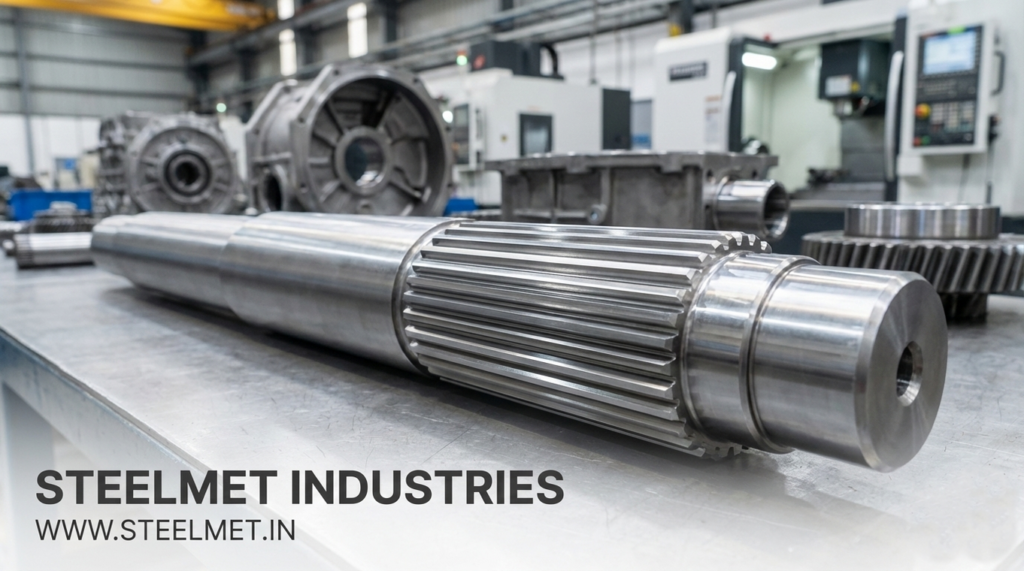
Splined Shaft – Steel Bright Bar Applications
A splined shaft is a torque-transmitting component featuring external or internal splines
that engage with mating parts such as gears, hubs, couplings or PTO assemblies.
Unlike keyed shafts, splines distribute torque across multiple teeth, reducing stress concentration
and improving load sharing under cyclic and shock loading.
For manufacturing splined shafts, steel bright bars are widely preferred as raw material
because they offer tight dimensional tolerances, high straightness, consistent metallurgy
and predictable machining behaviour. These characteristics are critical for spline accuracy,
fatigue life and long-term reliability in drivetrain and power transmission systems.
← Back to Automotive & Vehicle Components
|
← All Bright Bar Applications
Where Splined Shafts Are Used
- Automotive transmissions and differentials
- PTO and agricultural drivetrains
- Industrial gearboxes and reducers
- Construction and mining equipment
- General power transmission assemblies
Why Steel Bright Bars Are Used for Splined Shafts
- High torsional strength for reliable torque transfer
- Tight dimensional control for accurate spline fit
- Excellent straightness to maintain concentricity
- Uniform mechanical properties for fatigue resistance
- Good machinability for spline cutting or rolling
In spline applications, even minor variation in diameter, straightness or surface condition
can lead to uneven tooth loading, noise, premature wear or spline failure.
Bright bars reduce these risks by providing a consistent and controlled starting material.
Splined Shaft – Typical Geometry & Machined Features
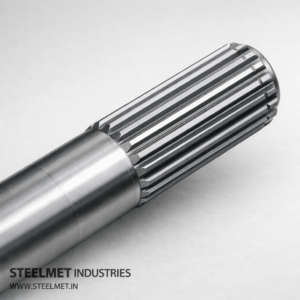
Typical splined shaft machined from steel bright bar with external spline teeth
Splined shafts typically incorporate spline teeth, bearing journals, shoulders and transition radii.
Accuracy of spline form, pitch, flank angle and concentricity directly affects load distribution,
assembly fit and service life.
Load Sharing & Stress Behaviour in Splined Shafts
Unlike keyed connections, splines distribute torque across multiple teeth.
However, improper material selection or machining inaccuracies can result in uneven load sharing,
leading to localised tooth stress and fatigue cracking.
| Design Factor | Impact on Performance | Bright Bar Advantage |
|---|---|---|
| Spline accuracy | Uniform load distribution | Controlled diameter and straightness |
| Surface finish | Reduced fretting and wear | Smoother machined spline flanks |
| Material consistency | Predictable fatigue life | Uniform metallurgy along length |
Common Steel Grades Used for Splined Shafts
| Application Type | Typical Steel Grades | Reason |
|---|---|---|
| Standard automotive & industrial use | EN8, EN8D, C45 | Balanced strength and machinability |
| Medium to heavy load applications | EN19 | Higher fatigue and torsional strength |
| High torque / fatigue-critical use | 42CrMo4, EN24 / 4340 | Superior toughness and heat treat response |
Typical Processing & Operations
- Cold drawn or peeled & polished bright bars
- CNC turning for diameter and shoulder control
- Spline cutting or spline rolling
- Induction or case hardening (as specified)
- Final inspection of spline geometry
Manufacturing & Supply Realities
From a manufacturing perspective, splined shafts demand straightness, concentricity
and sufficient machining allowance. Bright bars are typically supplied in straight lengths,
with controlled diameter tolerance to minimise stock removal during spline machining.
- Straightness is critical to avoid spline runout
- Consistent diameter reduces machining variation
- Heat treatment response must be predictable
- Traceability is essential for OEM and export supply
Where Bright Bars May NOT Be Suitable
Bright bars may not be ideal for extremely large cross-sections or forged spline designs
where grain flow orientation is critical. In such cases, forged or rolled blanks
may be more appropriate.
Buyer Decision Checklist
- Required torque and fatigue life
- Spline type and accuracy requirement
- Heat treatment method planned
- Straightness and concentricity limits
- Need for VD route steel
Why Steelmet Industries?
- Bright bars suitable for precision spline machining
- Supply of EN8, EN19 and alloy steel grades
- VD route steels for fatigue-critical splined shafts
- Inspection support via NABL-certified laboratories
- Consistent quality and traceability
FAQs
Why are splines preferred over keys?
Splines distribute torque across multiple teeth, reducing stress concentration
and improving load capacity.
Which steel grade is commonly used?
EN8 is common for standard applications, while EN19 and 42CrMo4 are selected for higher loads.
Are splined shafts heat treated?
Yes. Induction hardening or case hardening is often applied to improve wear resistance.
Is straightness important before spline machining?
Yes. Poor straightness can lead to spline runout and uneven tooth loading.
Contact for Enquiries
For sourcing steel bright bars for splined shaft manufacturing: