
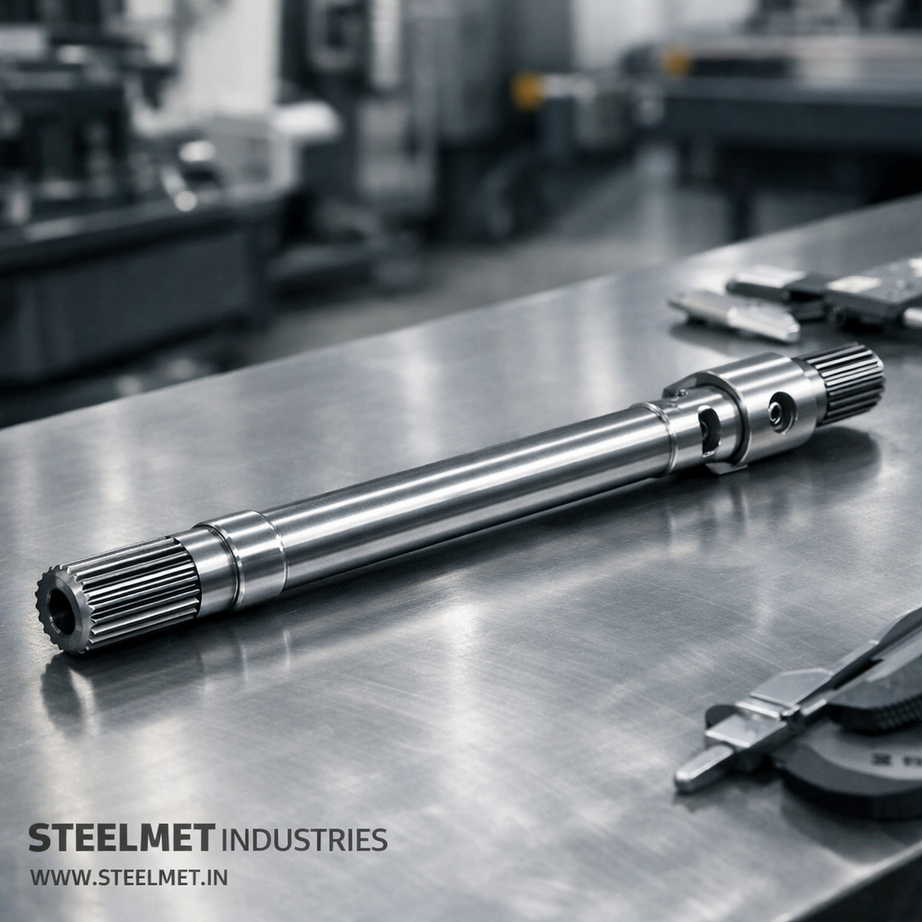
Steering Shaft – Steel Bright Bar Applications
A steering shaft is a critical safety-related component used to transmit driver input from the steering wheel
to the steering gear or rack. It operates under torsional load, vibration, repeated stress cycles and strict
dimensional requirements.
For this reason, steering shafts are commonly manufactured from steel bright bars that offer
controlled tolerances, excellent straightness and reliable mechanical properties.
← Back to Automotive & Vehicle Components
|
← All Bright Bar Applications
Where Steering Shafts Are Used
- Passenger vehicles and commercial vehicles
- Tractors and agricultural machinery
- Construction and earthmoving equipment
- Material handling and industrial vehicles
- Special-purpose and off-road vehicles
Why Steel Bright Bars Are Used for Steering Shafts
- High torsional strength for torque transmission
- Excellent straightness to prevent vibration and misalignment
- Tight dimensional tolerances for splines, serrations and joints
- Good surface finish reducing machining time
- Consistent properties for safety-critical applications
Steering Shaft – Typical Geometry & Machined Features
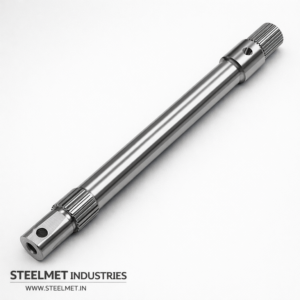
Steering shafts typically incorporate splines, keyways, universal joint interfaces or collapsible features,
all of which demand dimensional precision and predictable machining behaviour.
Common Steel Grades Used
| Application Type | Typical Steel Grades |
|---|---|
| Standard Automotive Steering Shafts | EN8, EN8D, C45 |
| Medium to Heavy Vehicle Applications | EN19 |
| High Load / Safety-Critical Shafts | 42CrMo4 |
Typical Processing & Operations
- Cold drawn or peeled & polished bright bars
- CNC turning and milling
- Spline rolling or spline cutting
- Induction hardening (select applications)
- Surface treatments as per OEM specification
Bright Bar Sections & Supply Form
- Round bright bars (most common)
- Custom diameters based on steering system design
- Straight lengths suitable for spline machining
Manufacturing & Quality Considerations
- Strict straightness control to avoid steering vibration
- Uniform chemistry for predictable heat treatment
- Surface integrity for spline durability
- Traceability for automotive and OEM supply chains
Related Components
- Intermediate Shafts
- Splined Shafts
- Universal Joint Shafts
Why Steelmet Industries?
- Bright bars with consistent tolerance and straightness
- Supply of EN8, EN19 and alloy steel grades
- VD route steels available for safety-critical components
- Testing support via NABL-certified laboratories
FAQs
Why is straightness important in steering shafts?
Poor straightness can lead to vibration, noise and premature joint wear in steering systems.
Which steel grades are commonly used for steering shafts?
EN8 and EN19 are commonly used, while 42CrMo4 is selected for higher load and safety-critical applications.
Are steering shafts considered safety-critical components?
Yes. Steering shafts are safety-critical and require controlled material properties and traceability.
Contact for Enquiries
For sourcing steel bright bars for steering shaft manufacturing: