
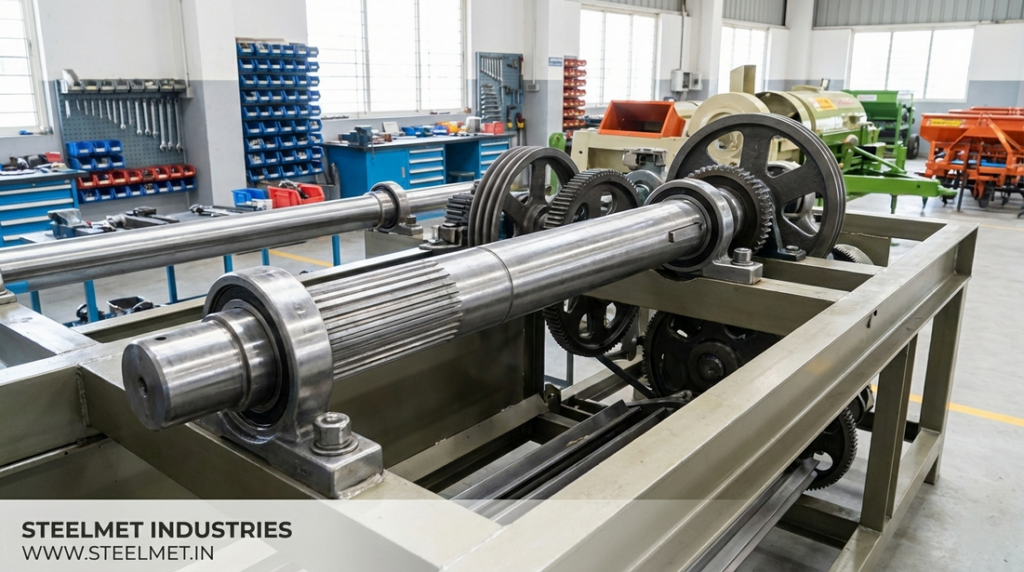
Thresher Shaft – Application of Steel Bright Bars in Crop Processing Machinery
Thresher shafts are critical rotating components used in agricultural threshers and post-harvest crop processing machines to transmit torque, support rotating drums, and sustain continuous impact and abrasion during grain separation operations. These shafts operate under demanding conditions involving fluctuating loads, cyclic bending stresses, vibration, dust ingress, and exposure to crop residue. For manufacturers of threshers and allied machinery, material selection for shafts directly affects machine uptime, maintenance frequency, and field reliability.
Steel bright bars are commonly used as raw material for manufacturing thresher shafts due to their dimensional accuracy, straightness, predictable mechanical properties, and machining readiness. Bright bars allow shaft manufacturers to maintain consistent tolerances, reduce machining variability, and achieve repeatable performance across production batches.
Operating Conditions and Load Characteristics in Threshers
Thresher shafts are subjected to combined torsional and bending loads generated by rotating beaters, concaves, straw walkers, and drive systems. During operation, the shaft experiences intermittent shock loading from uneven crop feed, cyclic fatigue from continuous rotation, and surface wear at bearing and coupling interfaces. Misalignment, imbalance, or material inconsistency can result in premature bearing failure, shaft bending, or fatigue cracking.
Because threshers often operate for extended hours during harvesting seasons with limited maintenance windows, shaft material must offer adequate strength, toughness, and dimensional stability while remaining economical for large-scale agricultural machinery production.
Why Bright Steel Bars Are Used for Thresher Shafts
Bright steel bars provide a controlled starting material for shaft manufacturing, enabling consistent machining and predictable in-service behaviour. Their improved surface finish compared to hot rolled bars reduces machining effort and helps maintain concentricity and straightness over long shaft lengths.
For thresher shafts, bright bars offer a balance between mechanical performance and cost, especially when produced from low carbon or medium carbon grades commonly used in agricultural equipment.
Common Steel Grades Used for Thresher Shafts
The following grades are widely used in the agricultural machinery sector for thresher shaft manufacturing, depending on load, shaft diameter, and duty cycle.
| Steel Grade | Typical Use in Threshers | Key Characteristics |
|---|---|---|
| MS (Mild Steel) | Light-duty shafts, low power threshers | Good machinability, economical, limited fatigue strength |
| Low Carbon (LC) | General-purpose shafts | Better consistency than generic MS, suitable for welding |
| SAE 1018 | Medium-duty rotating shafts | Improved strength and surface hardness compared to MS |
| EN8 | Higher load and fatigue-prone shafts | Higher tensile strength, suitable for induction hardening |
Functional Requirement vs Material Property
| Operational Requirement | Required Material Property | Bright Bar Advantage |
|---|---|---|
| Continuous rotation | Dimensional stability | Controlled tolerances and straightness |
| Shock loading | Toughness | Uniform microstructure from controlled steel grades |
| Bearing fit zones | Surface finish | Reduced machining and better bearing life |
| Field maintenance | Repairability | Common grades allow easy replacement and machining |
Manufacturing and Machining Considerations
Thresher shafts manufactured from bright bars are typically produced through turning, keyway milling, drilling, and in some cases induction hardening at bearing or wear zones. Straightness of the incoming bar is critical to avoid excessive material removal and to maintain balance during high-speed rotation. Machining allowances must be planned to accommodate any straightness correction or heat treatment distortion.
For EN8 shafts, selective surface hardening may be applied to improve wear resistance while maintaining a tough core. Lower carbon grades are generally used in applications where welding or field repair is anticipated.
Supply Realities for Thresher Shaft Raw Material
Bright bars for thresher shafts are commonly supplied in standard mill lengths, with cut-to-length options depending on order volume. Straightness tolerances are important for long shafts used in axial drum assemblies. Surface condition should be free from laps, seams, or excessive decarburisation to ensure machining reliability.
Typical agricultural machinery supply chains prioritise consistent grade availability, predictable lead times, and batch-to-batch uniformity over extreme metallurgical refinement.
Buyer Decision Checklist
- Confirm shaft duty cycle and peak load before grade selection
- Evaluate straightness requirements based on shaft length and speed
- Match grade to machining and heat treatment plans
- Assess field repair and replacement expectations
- Verify supply consistency for seasonal production demand
Where Bright Bars May NOT Be Suitable
Bright steel bars may not be suitable for extremely high-impact rotor shafts used in very large industrial threshers where forged components are specified. Applications requiring hollow shafts, specialised alloy steels, or dynamically balanced assemblies beyond standard agricultural tolerances may require alternative manufacturing routes.
FAQs
Are bright bars strong enough for thresher shafts?
Yes, when the correct grade is selected, bright bars provide adequate strength and fatigue resistance for typical agricultural threshers.
Is EN8 necessary for all thresher shafts?
No, EN8 is used for higher load or fatigue-prone applications, while MS and SAE 1018 are sufficient for lighter duty machines.
Can thresher shafts be induction hardened?
Yes, EN8 shafts are commonly induction hardened at bearing or wear locations.
Do bright bars reduce machining time?
Yes, improved surface finish and dimensional accuracy reduce turning time and tool wear.
Contact for Material Enquiries
For grade selection, size availability, and sourcing of bright steel bars for thresher shaft manufacturing: