
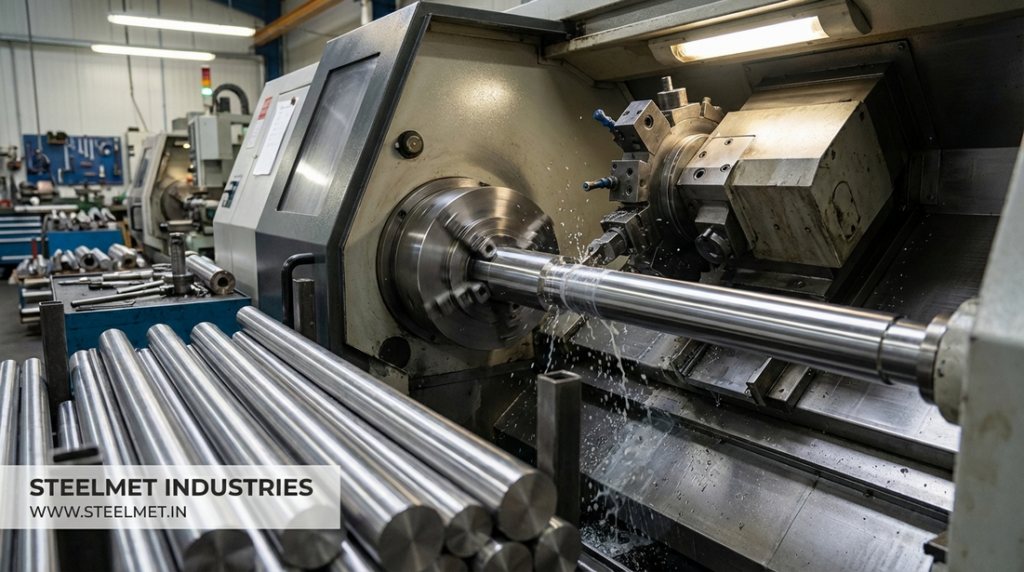
Tractor Shaft – Application of Steel Bright Bars in Agricultural Machinery
Tractor shafts are critical rotating and load-transmitting components used across tractors and tractor-mounted agricultural implements, including transmissions, drivetrains, auxiliary drives, and implement interfaces.
In Indian agricultural machinery manufacturing, tractor shafts are typically produced in high volumes and are expected to operate under cyclic loading, misalignment, dust exposure, and intermittent shock loads.
Bright steel bars are widely used as raw material for manufacturing tractor shafts because they offer controlled dimensional accuracy, predictable machinability, and consistent mechanical behaviour that supports reliable production and field performance.
Application Overview – Tractor Shafts
Tractor shafts are used in multiple locations such as gearbox input shafts, intermediate transmission shafts, auxiliary drive shafts, and implement drive interfaces where torque transmission and rotational stability are required.
These shafts are subjected to combined torsional loading, bending stresses, vibration, and surface wear during agricultural operations such as ploughing, harvesting, and power take-off driven activities.
Material selection for tractor shafts prioritises toughness, machinability, availability, and cost control rather than extreme alloying, making bright carbon steel bars a practical and scalable choice.
Why Bright Steel Bars Are Used for Tractor Shafts
Bright steel bars provide a controlled starting material that reduces machining variability and improves shaft straightness compared to hot rolled alternatives.
The improved surface finish of bright bars supports accurate turning, spline cutting, keyway machining, and bearing seat preparation without excessive stock removal.
Consistent diameter and straightness help maintain rotational balance, reduce vibration, and improve assembly repeatability in tractor drivetrain systems.
Grades Commonly Used for Tractor Shafts
Tractor shaft manufacturing in India commonly relies on low to medium carbon steels that balance strength, toughness, and machinability while remaining cost-effective and widely available.
| Grade | Typical Usage in Tractor Shafts | Key Characteristics |
|---|---|---|
| MS | Light-duty shafts and auxiliary drives | Good machinability, economical, moderate strength |
| Low Carbon (LC) | General-purpose transmission shafts | High toughness, easy machining, weld-friendly |
| SAE 1010 | Low-stress rotating shafts | Excellent ductility, consistent quality |
| SAE 1018 | Medium-duty tractor shafts | Better strength with good machinability |
| IS 2062 | Structural and load-sharing shafts | Balanced strength and availability |
| EN8 | High-load transmission shafts | Higher strength, suitable for heat treatment |
Functional Requirements vs Material Properties
| Functional Requirement | Material Property Needed | Bright Bar Advantage |
|---|---|---|
| Torque transmission | Tensile and torsional strength | Consistent mechanical properties |
| Rotational stability | Straightness and diameter control | Improved straightness over hot rolled bars |
| Machining accuracy | Uniform surface condition | Reduced tool wear and cycle time |
| Assembly fit | Tolerance consistency | Predictable fits across batches |
Manufacturing and Machining Considerations
Tractor shafts are typically produced through turning, facing, spline cutting, keyway milling, drilling, and optional heat treatment depending on load requirements.
Bright bars reduce setup variation on CNC and conventional lathes and allow tighter control over finished shaft dimensions.
Grades like EN8 may be normalised or induction hardened locally for improved wear resistance in bearing and spline zones.
Supply Realities for Tractor Shaft Raw Material
Bright steel bars for tractor shafts are commonly supplied in round sections with diameters selected based on finished shaft design and machining allowance.
Standard commercial lengths are typically supplied, with cutting performed by the component manufacturer to suit production flow.
Straightness and surface condition should be agreed upfront, especially for longer shafts where runout can affect vibration and bearing life.
Buyer Decision Checklist – Tractor Shaft Material
- Confirm grade selection based on torque and bending load
- Verify straightness tolerance for shaft length
- Assess machinability vs production cycle time
- Check heat treatment compatibility if required
- Ensure batch-to-batch dimensional consistency
Where Bright Steel Bars May NOT Be Suitable
Bright steel bars may not be suitable for tractor shafts requiring forged grain flow for extreme shock loading or where fully alloyed steels are mandated by OEM design.
Very large diameter or highly impact-loaded shafts may require forged or heat-treated alloy steel blanks instead of bright drawn bars.
FAQs – Tractor Shaft Material Selection
Are bright bars suitable for tractor transmission shafts?
Yes, bright bars are widely used for tractor transmission shafts due to their dimensional accuracy and consistent strength.
Is EN8 necessary for all tractor shafts?
No, EN8 is typically used for higher load shafts, while MS, LC, and SAE 1018 are sufficient for many applications.
Can tractor shafts made from bright bars be heat treated?
Yes, grades like EN8 can be induction hardened or normalised based on performance requirements.