
Anchor Bolt Applications Using Bright Steel Bars
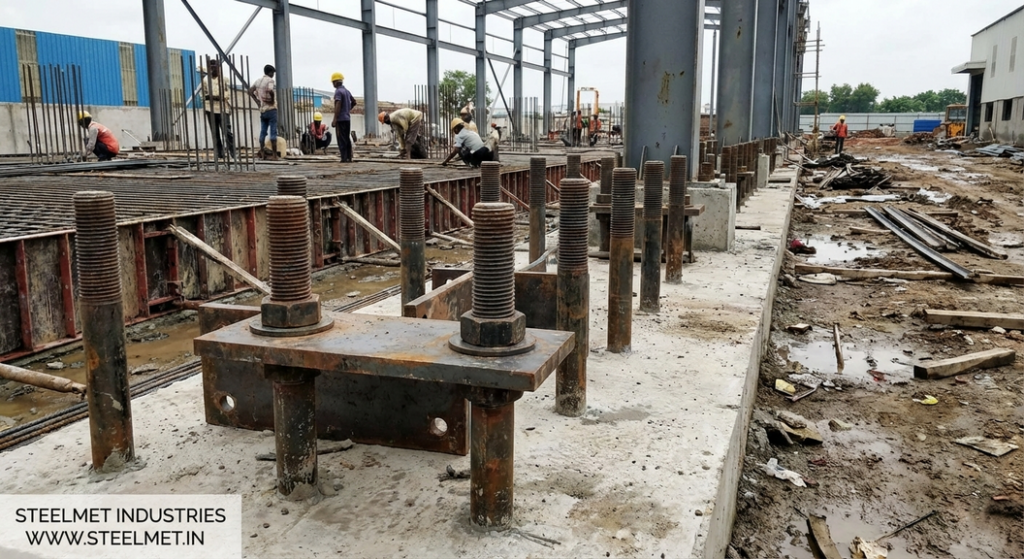
Anchor bolts are critical fastening components used to secure structural elements, machinery, and equipment to concrete foundations. From a manufacturing perspective, anchor bolts are load-carrying components that must reliably transfer tensile and shear forces from steel structures or equipment into concrete. Material selection directly influences thread integrity, dimensional stability, load performance, and installation reliability.
Bright steel bars are widely used as raw material for anchor bolt manufacturing because they offer controlled diameter, improved surface finish, and predictable mechanical properties. These characteristics simplify threading, bending, and inspection while improving consistency across production batches.
Where Anchor Bolts Are Used
- Structural steel column base plates
- Industrial machinery and equipment foundations
- Power plants, substations, and heavy installations
- Warehouses, sheds, and pre-engineered buildings
- Alignment and anchoring of capital equipment
Why Bright Steel Bars Are Preferred for Anchor Bolt Manufacturing
Anchor bolts rely on accurate geometry and reliable thread performance to achieve design load capacity. Bright steel bars provide a controlled starting material that supports these requirements better than hot rolled alternatives.
- Accurate diameter control supporting predictable tensile capacity
- Smooth surface finish enabling clean thread rolling or cutting
- Uniform mechanical properties along the full length
- Reduced tool wear during threading and bending operations
- Improved repeatability in batch manufacturing
Common Anchor Bolt Types Manufactured from Bright Bars
| Anchor Bolt Type | Typical Application | Manufacturing Requirement |
|---|---|---|
| L-Type | Steel columns and light structural supports | Accurate bending radius and pull-out resistance |
| J-Type | Machinery base plates | Controlled bending followed by precise threading |
| Straight Bolt | Chemical anchoring systems | High thread precision and surface quality |
| U-Type / Custom | Pipes, frames, OEM fixtures | Drawing-specific geometry and tolerances |
Manufacturing and Threading Considerations
Anchor bolt manufacturing typically involves multiple sequential operations, each influenced by raw material quality. Bright steel bars help maintain dimensional consistency throughout these steps.
- Cold drawn or peeled and polished bright bars used as input material
- Thread rolling or thread cutting depending on specification
- Bending operations performed before threading for L and J types
- Optional heat treatment for higher-strength requirements
- Surface protection such as galvanizing or coating when specified
Typical Steel Grades Used for Anchor Bolts
| Application | Typical Grade | Reason |
|---|---|---|
| General construction and structures | EN8, C45 | Balanced tensile strength and machinability |
| Heavy machinery foundations | EN19 | Higher tensile strength and fatigue resistance |
| Corrosive or outdoor environments | 304 / 316 | Improved corrosion resistance |
Where Bright Bars May NOT Be Suitable
Bright steel bars may not be suitable for anchor bolts involving very large diameters, forged heads, or applications with loose dimensional tolerance requirements. In such cases, hot rolled bars or forgings may be more economical. Final material selection must always comply with structural design codes and project specifications.
Buyer Decision Checklist
- Required tensile and shear load capacity
- Thread type and manufacturing method
- Corrosion exposure and coating compatibility
- Bending requirements and geometry control
- Batch size and dimensional repeatability
Supply and Manufacturing Realities
Anchor bolts are commonly produced in batches and supplied against project schedules. Bright steel bars are supplied in straight lengths with controlled tolerances, allowing predictable machining allowances and reduced rejection risk. Consistency in chemistry, diameter, and straightness is essential to avoid on-site installation issues.
FAQs
Are bright bars suitable for rolled threads?
Yes. Bright steel bars provide the surface quality and dimensional control required for reliable thread rolling.
Should bending be done before threading?
Yes. Bending is typically carried out before threading to prevent thread damage and distortion.
Do anchor bolts always require heat treatment?
No. Heat treatment is required only when higher strength or specification-driven performance is required.
Contact for Manufacturing Enquiries
For sourcing bright steel bars suitable for anchor bolt manufacturing, discuss your technical and supply requirements with our team.