
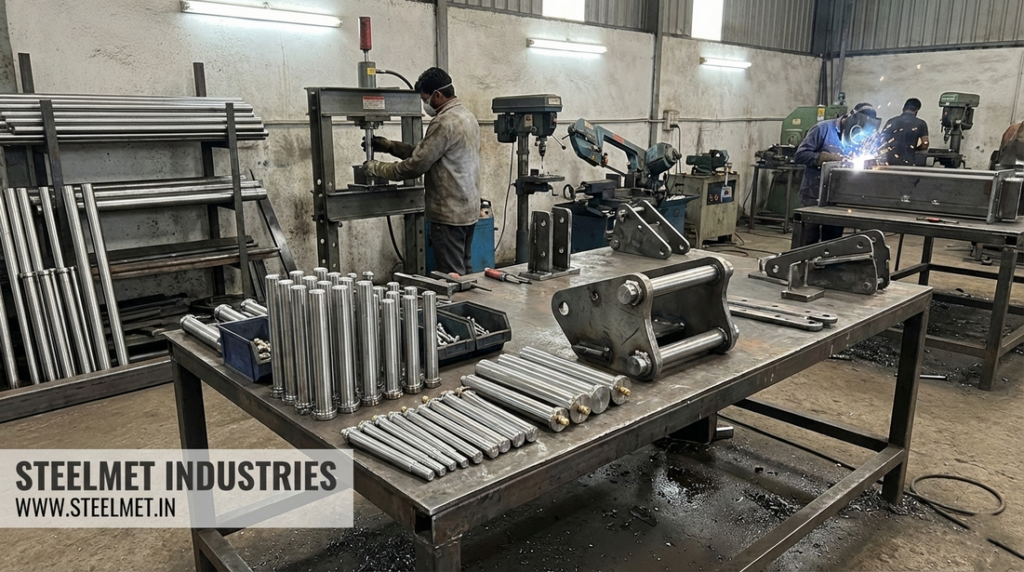
Fabrication Hinge Pins – Bright Steel Bar Applications
Fabrication hinge pins are cylindrical components used to provide controlled rotational movement between two fabricated parts.
They are widely used in gates, doors, enclosures, machinery covers, industrial frames, panels, and structural assemblies.
In service, hinge pins experience shear loading, bearing stresses between pin and hinge bore, repeated opening and closing cycles,
and progressive surface wear. Because of these operating conditions, material consistency and dimensional accuracy directly affect
service life and ease of maintenance.
For these reasons, bright steel bars are commonly used as raw material for manufacturing fabrication hinge pins.
Bright bars provide predictable geometry, controlled surface finish, and stable mechanical properties that simplify machining
and ensure repeatability across batches.
Where Fabrication Hinge Pins Are Used
Hinge pins are essential components in fabricated assemblies where alignment, durability, and ease of replacement are required.
| Hinge Pin Application | Load / Movement | Material Requirement |
|---|---|---|
| Industrial gates and doors | Moderate load, frequent rotation | Wear resistance, controlled clearance |
| Machinery access panels | Low load, repetitive opening | Smooth surface finish |
| Fabricated enclosures | Shear load, alignment critical | Dimensional accuracy |
| Heavy-duty hinges | High shear, limited rotation | Strength and toughness |
Why Bright Steel Bars Are Preferred for Hinge Pins
Bright steel bars provide a controlled and consistent starting material for hinge pin manufacturing.
Compared to hot rolled bars, bright bars offer superior dimensional control and surface quality,
which directly influence hinge performance and wear behaviour.
- Accurate diameter control for proper hinge fit
- Smooth surface finish reducing galling and wear
- Good machinability for chamfers, grooves, and cross-holes
- Uniform mechanical properties along the full length
- Reduced grinding and finishing operations
Fabrication & Machining Considerations
Fabrication hinge pins are typically produced in batches and must maintain interchangeability.
Bright bars simplify machining operations and reduce variability during production.
| Fabrication Process | Bright Bar Advantage | Outcome |
|---|---|---|
| Cutting to length | Straight material | Improved alignment in assembly |
| CNC turning | Uniform diameter | Consistent pin-to-bore fit |
| Grooving / drilling | Predictable machining response | Lower tool wear |
| Surface finishing | Smooth base surface | Reduced wear during operation |
Typical Steel Grades Used
| Industry | Hinge Pin Duty | Typical Grade | Reason |
|---|---|---|---|
| General fabrication | Light to medium duty | EN8 / C45 | Balanced strength and machinability |
| Industrial equipment | Repeated movement | EN8D | Improved surface finish |
| Heavy-duty hinges | High shear load | EN19 | Higher strength and fatigue resistance |
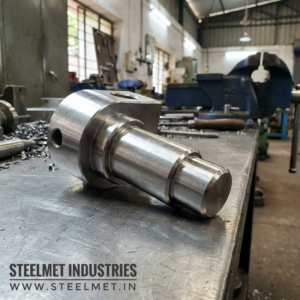
Wear, Lubrication & Service Behaviour
In most fabrication applications, hinge pins operate under boundary lubrication or dry conditions.
Surface finish and hardness directly influence wear rate at the pin–bore interface.
Bright steel bars provide a stable base material that can be further hardened or coated where required.
Decision Checklist for Fabricators and OEMs
- Required fit class (slip fit vs controlled clearance)
- Expected shear and bearing loads
- Cycle frequency and duty duration
- Wear life expectations and maintenance access
- Need for surface hardening or coating
Where Bright Bars May NOT Be Suitable
Bright steel bars may not be suitable where hinge pins are exposed to aggressive corrosion,
chemical washdowns, or outdoor environments without protective coatings.
In such cases, stainless steels or coated materials may be required.
Very large diameter pins or welded pin assemblies may also demand alternative material forms.
Supply Realities & Manufacturing Tolerances
Fabrication hinge pins are typically supplied in standard or drawing-specific lengths.
Bright steel bars offer consistent straightness and diameter tolerance, enabling predictable machining allowances.
If heat treatment or surface hardening is required, allowances must be planned to control distortion.
Batch-to-batch consistency and traceability are important for large fabrication programs.
FAQs
Why are bright bars preferred over black bars for hinge pins?
Bright bars provide better surface finish and tighter diameter control, resulting in smoother hinge movement and longer service life.
Do hinge pins require tight tolerances?
Yes. Proper fit between the pin and hinge bore is essential to avoid excessive play or seizure.
Can hinge pins be heat treated?
Yes. Induction hardening or surface treatments may be applied depending on load and wear requirements.
Are bright bars suitable for batch production?
Yes. Their dimensional consistency makes them ideal for repeat batch manufacturing.
Contact for Technical Discussion
For sourcing bright steel bars suitable for fabrication hinge pin manufacturing, discuss your requirements with our technical team.