
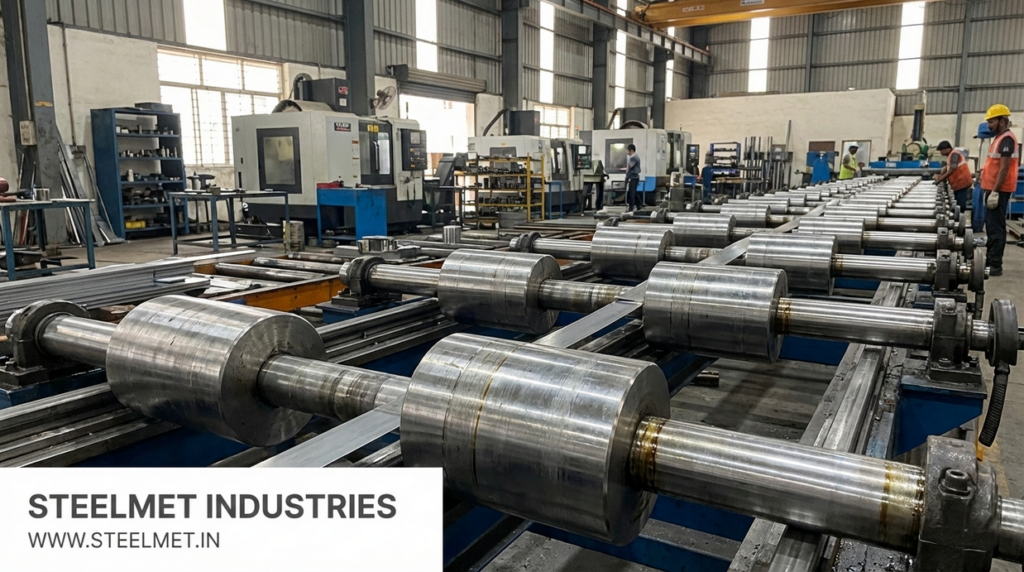
Bright Steel Bars for Guide Roller Manufacturing
Guide rollers are critical rotating or sliding components used to guide, support, align, or restrain moving elements in machines, conveyors, processing lines, and material-handling systems. Their performance depends heavily on dimensional accuracy, surface finish, wear resistance, and concentricity. For many guide roller designs, bright steel bars are selected as the preferred raw material because they provide predictable machining behaviour and reliable in-service performance.
This page explains the suitability of bright steel bars for manufacturing guide rollers, focusing on material behaviour, machining considerations, and application-driven selection rather than finished component sales.
What Guide Rollers Are and Where They Are Used
Guide rollers are typically cylindrical components that rotate or slide against belts, sheets, wires, profiles, or moving assemblies. They are designed to control motion paths, reduce friction, and prevent misalignment under load.
Common uses include conveyor systems, rolling mills, textile machinery, packaging lines, cable handling equipment, and fabrication setups where repeatable motion guidance is required.
Why Bright Steel Bars Are Preferred for Guide Rollers
Bright steel bars are cold-finished products with controlled dimensions and improved surface quality compared to hot rolled material. For guide rollers, these characteristics directly influence performance and service life.
- Consistent diameter and straightness for concentric machining
- Smoother surface finish reducing post-machining effort
- Uniform metallurgical structure for predictable wear
- Reduced stock removal during turning and grinding
- Better control over fit with bearings, bushes, or shafts
Common Guide Roller Applications and Requirements
| Roller Application | Load / Wear Condition | Material Requirement |
|---|---|---|
| Conveyor guide rollers | Continuous rotation, moderate load | Good surface finish, dimensional stability |
| Sheet guiding rollers | Sliding contact, surface wear | Uniform hardness, smooth finish |
| Cable & wire rollers | Abrasive contact | Wear resistance, consistent diameter |
| Textile machinery rollers | High speed, low vibration | Straightness, concentricity |
Typical Industries Using Guide Rollers
| Industry | Roller Type | Typical Grade | Reason |
|---|---|---|---|
| Material Handling | Conveyor guide rollers | EN8, C45 | Balanced strength and machinability |
| Textile Machinery | High-speed guide rollers | EN8D | Better finish and dimensional control |
| Processing Plants | Support and guide rollers | EN19 | Higher load capacity |
Manufacturing and Machining Considerations
Guide rollers are commonly manufactured by turning bright bar stock on lathes, followed by drilling, boring, or grinding depending on bearing or shaft fit requirements. Bright steel bars allow tighter control over finished dimensions due to their consistent starting size.
Operations such as external grinding, grooving, and surface treatment benefit from the lower surface variation typical of bright bars. This reduces tool wear and improves repeatability in batch production.
Decision Stage: Is Bright Steel the Right Material for Your Guide Rollers?
Bright steel bars are well suited when guide rollers require accurate geometry, moderate to high strength, and good surface finish without excessive secondary processing. They are especially effective in applications where rollers interact with bearings, bushes, or precision assemblies.
For manufacturers evaluating cost versus performance, bright bars often reduce total manufacturing cost even if the raw material price is higher than hot rolled alternatives.
Where Bright Steel Bars May NOT Be Suitable
Bright steel bars may not be the optimal choice in all scenarios. Applications involving extreme corrosion, aggressive chemicals, or very high abrasive wear may require stainless steels, coated materials, or alloyed alternatives. Similarly, large-diameter rollers with loose tolerances may not justify the use of cold-finished stock.
Supply Realities: Lengths, Tolerances, and Machining Allowances
Bright steel bars for guide roller manufacturing are typically supplied in standard or cut-to-length sizes. Diameter tolerances, straightness, and surface condition must be aligned with the machining process planned. Manufacturers should account for minimal machining allowance rather than heavy stock removal.
Batch consistency and traceability become critical when rollers are used in parallel assemblies or synchronized systems.
Frequently Asked Questions
Are bright steel bars suitable for hardened guide rollers?
Yes. Grades such as EN19 can be heat treated after machining to improve wear resistance.
Can guide rollers be ground directly from bright bar stock?
Yes. Bright bars are commonly used as pre-machined stock for external grinding.
What surface finish can be expected from bright steel bars?
They typically offer a smoother surface than hot rolled bars, reducing finishing effort.
Are custom diameters available for roller manufacturing?
Custom sizes can be supplied depending on grade and quantity requirements.
Contact for Manufacturing Enquiries
For selecting the appropriate bright steel grade and size for guide roller manufacturing, consult with a material specialist.