
Machine Shafts – Steel Bright Bar Applications
Machine shafts are core mechanical components used to transmit power, support rotating elements,
or maintain precise alignment within industrial equipment. They operate under combinations of
torsional load, bending stress, cyclic fatigue, and often high rotational speeds.
For these reasons, machine shafts are commonly manufactured from steel bright bars
that provide controlled dimensions, predictable mechanical properties, and consistent machinability.
What Is a Machine Shaft and Where Is It Used?
A machine shaft is a rotating or stationary cylindrical component designed to transmit torque,
support gears, pulleys, sprockets, bearings, or couplings, or maintain positional accuracy between
mechanical assemblies. Unlike generic rods, shafts are precision-engineered parts with strict
requirements for straightness, concentricity, surface finish, and metallurgical consistency.
Machine shafts are used across a wide range of industries including general engineering, industrial
machinery, automation equipment, pumps, compressors, conveyors, and power transmission systems.
Why Bright Steel Bars Are Preferred for Machine Shafts
Bright steel bars are widely selected as shaft raw material because they reduce downstream processing
risk and improve manufacturing repeatability. Compared to hot rolled bars, bright bars offer tighter
dimensional tolerances and superior surface condition before machining begins.
- Controlled diameter and straightness suitable for rotating components
- Improved surface finish reducing machining and grinding time
- Uniform mechanical properties along the entire length
- Reliable response to heat treatment processes
- Lower material removal and scrap during turning
Typical Machine Shaft Applications and Requirements
| Shaft Application | Load / Speed Condition | Material Requirement |
|---|---|---|
| Transmission shafts | High torque, moderate speed | High torsional strength and fatigue resistance |
| Motor and rotor shafts | High speed, balanced rotation | Straightness and concentricity control |
| Pump and compressor shafts | Continuous duty, cyclic load | Uniform metallurgy and surface integrity |
| Conveyor shafts | Bending load, low speed | Dimensional stability and machinability |
Industries Using Bright Bar Machine Shafts
| Industry | Shaft Type | Typical Grade | Reason for Selection |
|---|---|---|---|
| General engineering | Drive and support shafts | EN8 / C45 | Balanced strength and machinability |
| Industrial machinery | Gearbox shafts | EN19 | Higher torque and fatigue resistance |
| Automation equipment | Precision shafts | EN8D | Dimensional accuracy and surface finish |
| Heavy-duty applications | Power transmission shafts | 42CrMo4 | High load and shock resistance |
Machining and Manufacturing Considerations
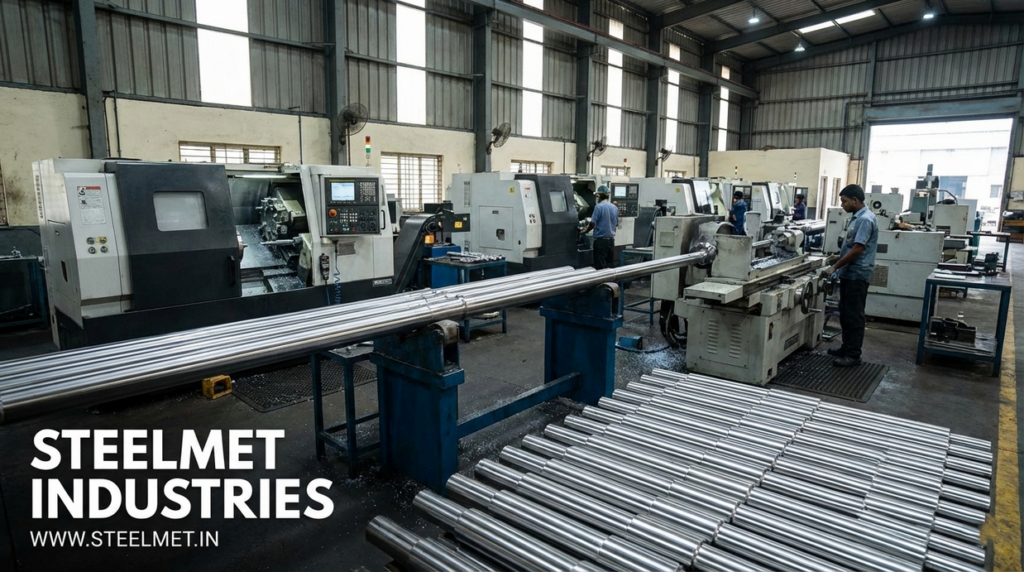
Machine shafts manufactured from bright steel bars typically undergo CNC turning, grooving,
threading, keyway cutting, spline machining, and in some cases grinding. Bright bar feedstock
allows manufacturers to maintain predictable tool life and dimensional repeatability.
| Machining Operation | Bright Bar Advantage | Outcome |
|---|---|---|
| CNC turning | Uniform diameter and surface | Consistent cycle times |
| Grinding | Low surface defects | Improved bearing fit |
| Threading / keyways | Stable metallurgy | Reduced tool wear |
Where Bright Bars May NOT Be Suitable
Bright steel bars may not be the optimal choice where shafts require very large diameters,
non-cylindrical forged geometries, or extreme impact resistance. Applications involving
severe shock loading or very large cross-sections may require forged or rolled components
instead of cold-finished bars.
Decision Factors for Machine Shaft Manufacturers
When selecting bright steel bars for shaft manufacturing, engineers and buyers should evaluate
load conditions, required straightness, machining allowance, heat treatment route, and end-use
criticality. Choosing the correct grade and bar condition early reduces downstream rejection and
field failure risk.
Supply Realities and Practical Considerations
Bright steel bars for machine shafts are typically supplied in straight lengths with controlled
diameter tolerances. Allowance must be made for machining stock, especially when grinding or
heat treatment is involved. Straightness, surface condition, and traceability are critical for
batch consistency in OEM production environments.
Frequently Asked Questions
Are bright bars suitable for high-speed rotating shafts?
Yes. Bright bars offer superior straightness and dimensional control, making them suitable for
balanced and high-speed shaft applications.
Which steel grade is most commonly used for machine shafts?
EN8 and EN19 are widely used depending on load and fatigue requirements.
Can bright bars be heat treated after machining?
Yes. Bright bars respond predictably to induction or through hardening when chemistry is controlled.
Do bright bars reduce machining time?
Yes. Improved surface finish and dimensional accuracy reduce cutting passes and tool wear.
Contact for Engineering Enquiries
For sourcing steel bright bars suitable for machine shaft manufacturing:
For grade selection or application discussion, you may also
request a technical consultation.