
Guide Rod – Steel Bright Bar Applications
A guide rod is a precision linear guidance component used to maintain
alignment and controlled movement in mechanical, hydraulic and automation systems.
Unlike power-transmitting shafts, guide rods primarily ensure accurate linear motion,
load alignment and stability under repetitive sliding contact.
They operate under bending loads, surface contact stress and continuous motion cycles.
For these reasons, guide rods are commonly manufactured from steel bright bars
that offer high straightness, consistent diameter, controlled surface finish and
predictable machining behaviour. These properties are essential to prevent binding,
uneven wear and premature failure in linear guidance systems.
← Back to Hydraulics & Pneumatics
|
← All Bright Bar Applications
Where Guide Rods Are Used
- Hydraulic cylinders and linear actuators
- Industrial automation and robotic systems
- Press machines and molding equipment
- Material handling and lifting systems
- Packaging, assembly and inspection machinery
Why Steel Bright Bars Are Used for Guide Rods
- High straightness ensures smooth, binding-free linear motion
- Superior surface finish reduces friction and wear
- Consistent diameter improves alignment accuracy
- Good machinability for threaded ends and shoulders
- Uniform mechanical properties along the full length
Guide Rod – Typical Geometry & Surface Condition
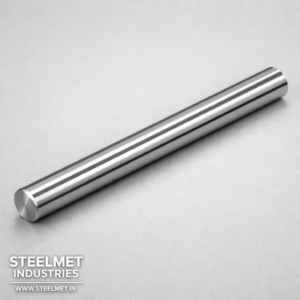
Guide rods are typically cylindrical with tight diameter tolerances.
They may incorporate threaded ends, shoulders or mounting features.
Surface condition is critical, as the rod operates in sliding contact
with bushings, bearings or guide blocks.
Common Steel Grades Used for Guide Rods
| Application | Typical Grade | Reason |
|---|---|---|
| Standard industrial machinery | EN8D, C45 | Balanced strength, machinability and availability |
| Medium load & precision systems | EN19 | Higher strength and better fatigue resistance |
| High load & cyclic duty | 42CrMo4 | Improved toughness and load capacity |
Manufacturing & Machining Considerations
| Operation | Bright Bar Advantage | Outcome |
|---|---|---|
| Precision grinding | Uniform starting diameter | Consistent final tolerance |
| Thread machining | Clean surface and stable core | Accurate threads, reduced tool wear |
| Surface hardening | Controlled chemistry | Predictable hardness depth |
Manufacturing & Quality Considerations
- Straightness control to avoid binding during operation
- Surface integrity for wear resistance in sliding contact
- Dimensional inspection for consistent fit
- Traceability for OEM and industrial supply
Where Bright Bars May NOT Be Suitable
Steel bright bars may not be ideal where guide rods are exposed to
extreme corrosion without surface protection, severe abrasive contamination,
or very high impact loads. In such cases, stainless steels, hard chrome plated
rods or alternative materials may be more appropriate.
Buyer Decision Checklist
- Required straightness over full rod length
- Surface finish specification for sliding contact
- Load and duty cycle of the application
- Heat treatment or surface hardening requirement
- Length, diameter tolerance and batch size
Related Components
- Hydraulic Cylinder Shafts
- Piston Rods
- Shock Absorber Rods
Why Steelmet Industries?
- Bright bars suitable for precision linear guidance
- Supply of EN8D, EN19 and alloy steel grades
- VD route steels for fatigue-critical applications
- Inspection support via NABL-certified laboratories
FAQs
Why is straightness critical for guide rods?
Poor straightness causes misalignment, increased friction and uneven wear
in linear motion systems.
Which steel grade is commonly used?
EN8D is widely used for standard applications, while EN19 is preferred
for higher load and longer service life.
Can guide rods be surface hardened?
Yes. Induction hardening or surface treatments may be applied to improve
wear resistance depending on operating conditions.
Contact for Enquiries
For sourcing steel bright bars for guide rod manufacturing: