
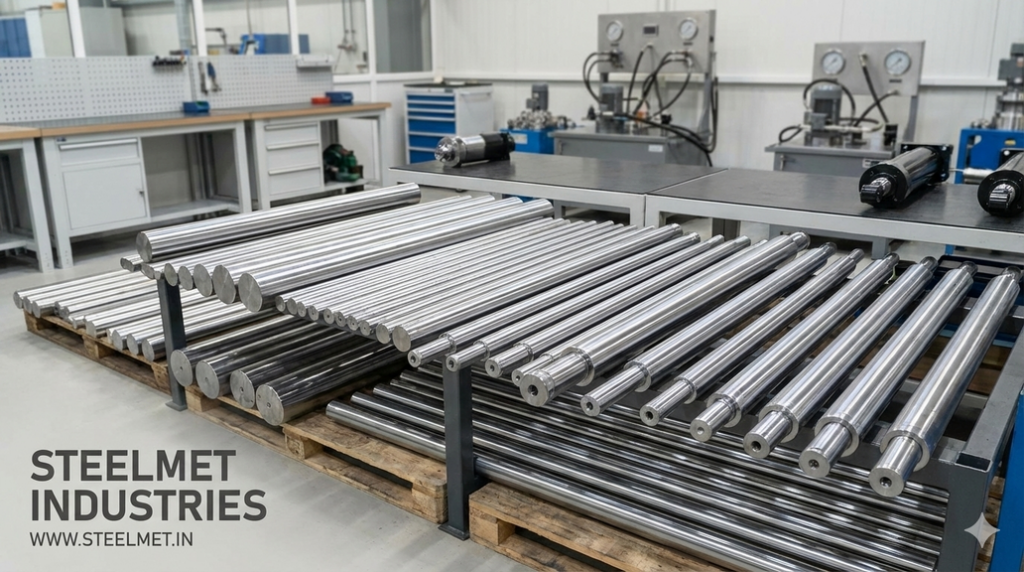
Hydraulics & Pneumatics – Applications of Steel Bright Bars
This application falls under the Shafts, Transmission & Hydraulics segment, where bright steel bars are used for pressure-bearing, sliding and load-critical components in hydraulic and pneumatic systems. In these systems, component reliability depends heavily on straightness, surface integrity, dimensional accuracy and predictable mechanical performance under repetitive pressure cycles.
← Back to Shafts, Transmission & Hydraulics | ← All Bright Bar Applications
Why Bright Steel Bars Are Used in Hydraulic & Pneumatic Systems
- Superior surface finish essential for sealing performance and low friction movement
- High straightness to prevent side loading, seal damage and uneven wear
- Controlled dimensional tolerances for precision-machined valve and actuator parts
- Consistent mechanical properties for cyclic pressure and fatigue loading
- Compatibility with grinding, honing, chrome plating and induction hardening
Typical Hydraulic & Pneumatic Components Manufactured
- Hydraulic piston rods and ram rods
- Hydraulic cylinder shafts
- Valve spools, sleeves and internal valve components
- Pneumatic actuator rods
- Guide rods, tie rods and end fittings
Common Steel Grades Used
| Component | Typical Grades |
|---|---|
| Piston Rods | EN8D, EN19 |
| Hydraulic Cylinder Shafts | C45 / EN8, EN19 |
| Valve Components | 20MnCr5, 16MnCr5 |
| Pneumatic Actuator Rods | EN8D, EN8 |
Hydraulic Performance Requirement vs Bright Bar Advantage
| Performance Requirement | Impact on System | Bright Bar Advantage |
|---|---|---|
| Straightness over length | Prevents seal wear and rod binding | Controlled cold-drawn or peeled straightness |
| Surface finish | Seal life and leakage control | Low Ra surface suitable for grinding and plating |
| Dimensional accuracy | Valve response and fit consistency | Tight tolerance bright bar supply |
| Fatigue resistance | Service life under pressure cycling | Uniform microstructure and VD route availability |
Buyer / Engineer Decision Checklist
- Confirm straightness requirements based on cylinder length and stroke
- Specify surface finish targets based on seal design and pressure rating
- Select grade based on pressure, fatigue life and heat treatment needs
- Evaluate machinability for threading, grinding and honing operations
- Assess VD route requirement for fatigue-critical or high-pressure systems
Supply Realities for Hydraulic Applications
Hydraulic and pneumatic components demand consistent raw material quality to avoid seal failures, leakage and premature wear. Bright steel bars are typically supplied in straight lengths with controlled diameter tolerances suitable for grinding and honing. Straightness expectations tighten as rod length increases, and machining allowances must account for surface finishing operations such as chrome plating or induction hardening.
For OEM and maintenance-driven demand, batch consistency is critical. Variations in chemistry, hardness or straightness between lots can directly impact assembly performance and field reliability. Buyers should align material specifications with realistic lead times for inspection, testing and finishing processes.
Where Bright Bars May NOT Be Suitable
Bright steel bars may not be suitable for extremely large diameter hydraulic rams where forged or cast components are structurally preferred. Applications involving extreme shock loading without appropriate heat treatment may also exceed the performance limits of standard bright bars. In highly corrosive environments without protective coatings, alternative materials or stainless steels may be required.
Related Applications
- Tooling, Shafts & Power Transmission
- Heavy Engineering & Earthmoving
- Industrial Machinery Components
Why Steelmet Industries?
- Surface finish suitable for sealing and sliding hydraulic components
- Controlled straightness for long piston and cylinder rods
- Wide availability of carbon and alloy steel grades
- VD route steels for pressure- and fatigue-critical systems
- Inspection and testing through NABL-certified laboratories
FAQs
Why is straightness critical for hydraulic piston rods?
Straightness directly affects seal life, rod alignment and side loading within the cylinder.
Can bright bars be used for chrome-plated hydraulic rods?
Yes. Bright bars provide a suitable base material for grinding and chrome plating operations.
Are VD route steels necessary for all hydraulic systems?
No. VD route steels are typically specified for high-pressure, fatigue-critical or long-life applications.
Contact for Enquiries
For technical discussions, drawings or sourcing of bright steel bars for hydraulic and pneumatic applications: