
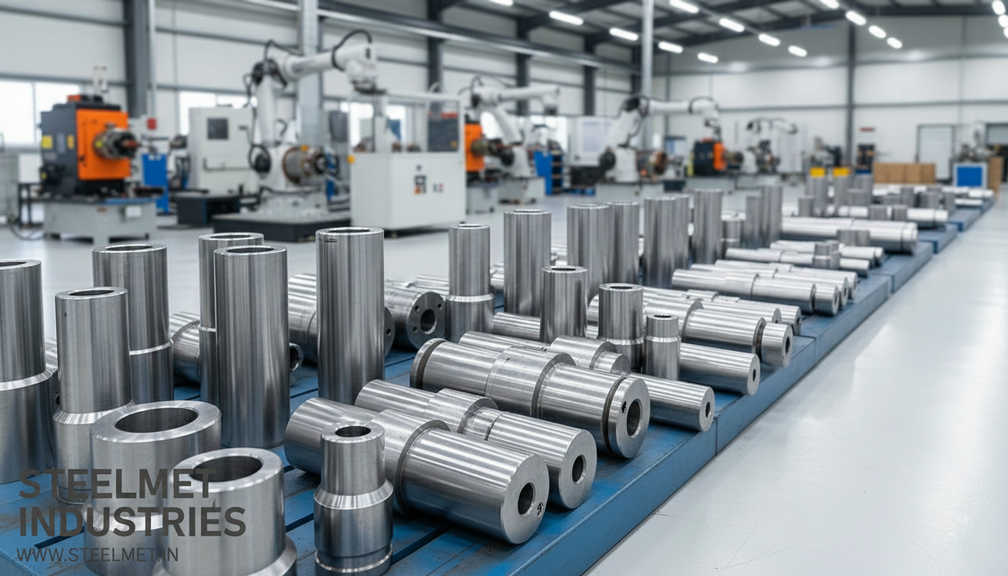
Industrial Machinery Components – Applications of Steel Bright Bars
This application falls under the Shafts, Transmission & Hydraulics segment, where bright steel bars are used for precision-machined, load-bearing and continuously operating machinery components. In industrial machinery, bright bars are preferred for their dimensional accuracy, machinability, mechanical consistency and ability to support reliable, long-term operation.
← Back to Shafts, Transmission & Hydraulics | ← All Bright Bar Applications
Industrial Machinery Application Context
Industrial machinery components typically operate under continuous or semi-continuous duty cycles where dimensional stability, alignment and predictable wear behaviour directly affect machine uptime and maintenance cost. Bright steel bars are commonly selected where shafts, rods and rotating elements must maintain straightness and surface integrity over long operating hours.
Unlike intermittent-duty equipment, industrial machinery often runs for extended periods with limited shutdown windows. Load paths are usually well-defined, but misalignment, vibration and localized wear can quickly lead to bearing failure or seal damage if material selection is incorrect.
Why Bright Steel Bars Are Used in Industrial Machinery
- Tight dimensional tolerances for precision fits and assemblies
- Good machinability for complex geometries and repeated operations
- Consistent mechanical properties for continuous-duty machinery
- Superior surface finish reducing wear and friction
- Compatibility with heat treatment for strength and wear resistance
Typical Industrial Machinery Components Manufactured
- Machine shafts and drive shafts
- Guide rods and support rods
- Bushings, sleeves and spacers
- Couplings, hubs and yokes
- Jigs, fixtures and tooling elements
Industrial Component vs Duty Characteristics
| Component Type | Duty Cycle | Key Material Requirement |
|---|---|---|
| Drive & Line Shafts | Continuous rotation | Straightness, fatigue resistance |
| Guide Rods | Sliding / reciprocating | Surface finish, wear resistance |
| Couplings & Hubs | Torsional loading | Dimensional accuracy, toughness |
| Bushings & Sleeves | Bearing contact | Roundness, machinability |
Common Steel Grades Used
| Component | Typical Grades |
|---|---|
| Shafts & Guide Rods | C45 / EN8, EN8D |
| Bushings & Sleeves | EN8, EN9 |
| Couplings & Hubs | EN19, 42CrMo4 |
| Tooling & Fixtures | EN19, EN24 / 4340 |
Bright Bar Sections Commonly Used
- Rounds
- Squares
- Flats
- Hexagons
- Custom sections as per machinery drawings
Buyer Decision Checklist – Industrial Machinery
- Confirm duty cycle (continuous vs intermittent) and select grade accordingly
- Match shaft diameter to load and allowable deflection limits
- Specify straightness requirements for long rotating components
- Evaluate surface finish needs for sliding or bearing-contact parts
- Assess machinability versus tool life for batch production
- Verify heat-treatment compatibility if surface hardening is required
Supply Realities for Industrial Machinery Components
Bright steel bars for industrial machinery are typically supplied in straight lengths suitable for cutting and machining. Diameter selection is often driven by standard bearing sizes and housing constraints rather than raw strength alone.
Straightness over length is a critical parameter for drive shafts and guide rods, especially where post-machining grinding or honing is planned. Machining allowances must be realistic to account for surface finishing while avoiding unnecessary material removal.
For maintenance spares and repeat OEM requirements, batch-to-batch consistency in chemistry and dimensional tolerance is essential to avoid fitment issues during installation.
Where Bright Steel Bars May NOT Be Suitable
Bright steel bars may not be suitable for large fabricated machine frames, cast housings or components primarily designed as weldments. Extremely high shock-load applications without appropriate heat treatment may require forged or cast alternatives. In cases where complex internal geometries are needed, castings may be more practical than machined bright bar components.
FAQs
Are bright bars suitable for continuous-duty industrial machinery?
Yes. Bright bars are commonly used in continuous-duty applications due to their dimensional stability and predictable wear behaviour.
How important is straightness in industrial machinery shafts?
Straightness directly affects vibration, bearing life and alignment, making it a critical selection factor for rotating machinery.
Can the same bright bar grade be used for shafts and bushings?
Not always. Shafts and bushings experience different stress and wear modes, so grade selection should be component-specific.
Contact for Enquiries
For technical discussions, drawings or sourcing of bright steel bars for industrial machinery components: