
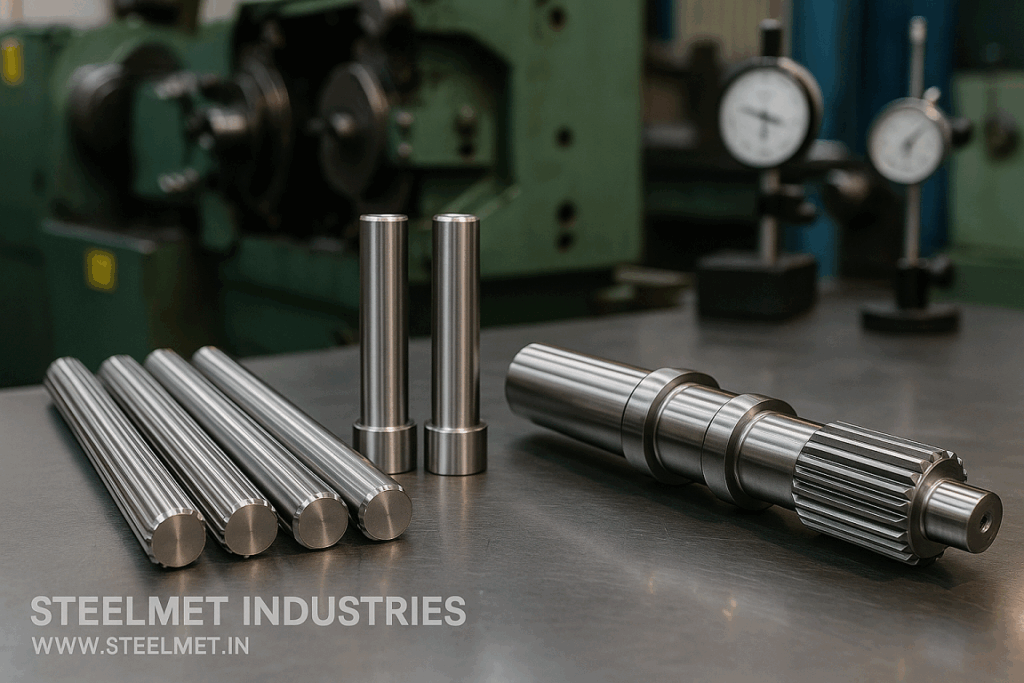
Tooling, Shafts & Power Transmission Parts – Applications of Steel Bright Bars
This application falls under the Shafts, Transmission & Hydraulics segment, where bright steel bars are used as raw material for torque-transmitting, rotating and load-bearing components used inside industrial machines, gearboxes, couplings and driven systems.
In tooling and power transmission applications, bright steel bars are selected primarily for their straightness, dimensional consistency, fatigue performance and predictable machining behaviour, all of which directly influence alignment accuracy, torque transfer efficiency and service life of the finished component.
← Back to Shafts, Transmission & Hydraulics | ← All Bright Bar Applications
Application Context: Tooling & Power Transmission Systems
Tooling shafts and power transmission shafts operate under combined torsional, bending and axial loads, often in continuous-duty or high-cycle environments where misalignment, vibration and fatigue can rapidly lead to premature failure.
Unlike general structural components, these shafts demand tight straightness control, accurate diameter tolerances and consistent surface condition to ensure proper bearing fit, spline engagement, gear alignment and load sharing across mating components.
Why Bright Steel Bars Are Used in Tooling & Power Transmission
- High torsional strength required for torque transmission
- Excellent straightness to minimise vibration and misalignment
- Tight dimensional tolerances for splines, keyways and press fits
- Uniform mechanical properties for fatigue-critical service
- Compatibility with induction hardening and case hardening
Typical Tooling & Power Transmission Components
- Transmission shafts and drive shafts
- Splined, serrated and keyway shafts
- Coupling shafts and intermediate shafts
- Tool holders, mandrels and arbors
- Gearbox shafts and power transmission pins
Application vs Load & Duty Characteristics
| Component Type | Typical Load / Duty | Why Bright Bars Are Used |
|---|---|---|
| Transmission Shafts | Continuous torsion and bending | Straightness and fatigue resistance |
| Splined & Keyway Shafts | High torque with cyclic loading | Dimensional accuracy and surface quality |
| Coupling Shafts | Misalignment compensation | Consistent geometry and machinability |
| Tooling Mandrels | Precision alignment and rigidity | Roundness and predictable machining |
Performance Requirement vs Bright Bar Advantage
| Requirement | Impact on Performance | Bright Bar Advantage |
|---|---|---|
| Straightness | Reduced vibration and bearing wear | Controlled straightness over length |
| Surface Finish | Improved bearing and seal life | Smoother as-drawn or peeled surface |
| Dimensional Tolerance | Accurate fits and alignment | Lower machining stock requirement |
| Machinability | Tool life and cycle time control | Uniform microstructure |
Common Steel Grades Used
| Component | Typical Grades |
|---|---|
| Transmission & Drive Shafts | EN8, EN19, 42CrMo4 |
| Splined & Keyway Shafts | EN24 / 4340 |
| Tooling & Mandrels | EN19, 42CrMo4 |
| Gearbox & High Torque Shafts | EN24 / 4340, EN19 |
Buyer Decision Checklist
- Confirm torque, bending and fatigue load requirements
- Match shaft diameter and grade to duty cycle
- Evaluate straightness requirements for rotation and alignment
- Assess surface finish needs for bearings, splines or seals
- Ensure grade suitability for planned heat treatment
- Consider repeatability and batch-to-batch consistency
Supply Realities for Tooling & Power Transmission Shafts
Bright steel bars for tooling and power transmission applications are typically supplied in straight lengths with controlled diameter tolerances suitable for turning, spline cutting, grinding and heat treatment.
Diameter ranges and lengths vary by application, but straightness over length, machining allowance and consistency across batches are critical for repeat production and maintenance spares. Procurement teams must account for realistic cutting losses, heat treatment distortion allowances and inspection rejection risk.
Where Bright Bars May NOT Be Suitable
Bright steel bars may not be appropriate for very large diameter shafts requiring forged grain flow, components subjected to extreme shock loading without subsequent heat treatment, or applications where casting or fabricated assemblies are structurally more appropriate. Material selection must always align with the mechanical design intent.
FAQs
Why is straightness critical in power transmission shafts?
Poor straightness causes misalignment, vibration and accelerated bearing and coupling wear.
Which grades are preferred for high-torque transmission shafts?
EN19 and EN24 are commonly selected for their strength and fatigue resistance.
Can bright bars be heat treated after machining?
Yes. Bright bars are commonly induction hardened or case hardened depending on grade.
Contact for Enquiries
For technical discussions, drawings or sourcing of bright steel bars for tooling, shafts and power transmission components: